
Management
What are the animal welfare benefits of an electronic identification (NLIS) tag for farm animals?
An electronic identification tag enables farm animals to be tracked from their property of birth through to slaughter. The National Livestock Identification System (NLIS) tag is placed in the animal’s ear and stays with the animal on farm, during transport, at saleyards and at the abattoir.
Is tethering of farm animals acceptable?
Tethering is where an animal is fastened by a chain to a central anchor point, causing it to be confined to a specific area.
What influences animal welfare at saleyards?
Saleyards are public delivery and collection points to which animals are transported to be sold to the highest bidder and from where animals are then transported to their final destination.
Does using paintball guns to identify animals cause harm?
Paintball guns are pneumatic firearms driven by compressed gas.
What is swill and can I feed it to pigs, poultry or other farm animals?
Swill is any animal food that contains animal matter such as meat, meat products or meat by-products. It is illegal in Australia to feed swill to pigs. In Queensland, it is illegal to feed swill to any livestock including pigs, poultry and ruminants.
What are antimicrobials and why are they used in livestock production?
Antimicrobials are agents that kill, or stop the growth of, microorganisms such as bacteria, viruses, fungi, parasites and protozoa. Antibiotics are commonly used to treat bacterial infections in humans and animals.
Why can’t the RSPCA prosecute farmers for keeping animals in intensive systems?
Intensive farming methods involve removing animals from their natural environments and keeping them housed or confined for all, or a large part, of their lives. They are raised in large numbers under controlled conditions, commonly involving use of hormones, antibiotics and vaccines.
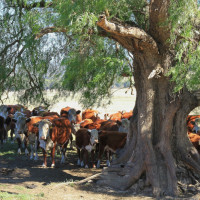
Why are livestock left in paddocks without shade?
It is common to see all types of animals in the heat without protection from the sun. While farm animals have various ways of coping with heat, a very important one is to seek shelter or shade.
What are the animal welfare issues with genetic modification of farm animals?
Genetic modification (GM) of farm animals started in the early 1980s. Most research on GM farm animals (cattle, sheep, pigs, chickens and goats) has been carried out in the United States, Australia, New Zealand and Japan.
What are the animal welfare issues with cloning of farm animals?
In a world first, a sheep named Dolly was born in 1996. She was a clone of her mother, created using the genetic material from a cell in the ewe’s udder. Dolly sparked an intense public debate on cloning.