

Why do birds chew and pull out their feathers?
Feather damaging behaviour (FDB) is damage to, or destruction of, a bird’s feathering by the birds themselves. It can include a number of behaviours including:
- Feather chewing – the bird chews at the ends of their feathers, damaging the vane.
- Feather barbering – the bird chews along the entire length of the feather shaft.
- Feather plucking – the bird pulls a complete feather out.
- Feather picking – the bird bites the feather off at the level of the skin.
- Feather snapping – the bird breaks the feather shaft, leaving the end of the feathers ending in a “v” shape.
This is one of the most common and most frustrating conditions that companion bird owners and avian vets are presented with (not to mention the underlying stress to your bird).
The causes for this condition are many and they often seem to trigger other factors, magnifying the problem. In fact, by the time the bird is presented to an avian vet, the original cause may have disappeared or been obscured by other complicating or reinforcing factors.
Causes
Feather damaging behaviour may be due to either physical or behavioural problems. It is simplistic and inaccurate to diagnose ‘boredom’ or ‘fear/anxiety’ without a thorough investigation by your avian vet to rule out physical problems first. This will require blood tests and possible skin biopsies and even X-rays to make sure there isn’t an underling problem causing pain and discomfort that leads to the FDB.
It is also simplistic to think that a single cause exists for each individual case. In many cases several factors, both physical and behavioural, have combined to produce the clinical sign of feather damaging behaviour.
Possible causes of feather damaging behaviour
Dermatitis/Folliculitis – bacterial, fungal, or allergic |
Anxiety |
Malnutrition |
Fear |
Cigarette smoke and other pollutants |
Boredom |
Internal painful diseases such as cancer |
Attention-seeking |
External parasites |
Stereotypic behaviour |
Breeding behaviour |
Prolonged reproductive behaviour |
Climate extremes – too hot, too dry, too wet |
Sleep deprivation |
Treatment
What doesn’t work:
- Behavioural drugs – these usually sedate the bird rather than fixing the problem.
- Collars may physically prevent the bird from chewing, etc., but don’t solve the cause.
- Punishing your bird e.g., shouting at them, squirting them with a water pistol.
What may work:
- Identifying and removing risk factors (use the above list as a guide). Be particularly mindful of anything in the bird’s environment or experience that might have changed recently.
- Develop and introduce an environmental enrichment plan.
- Consider carefully whether social enrichment through introducing a new bird for companionship might help – or worsen – the problem.
- Provide safe, alternative chewing opportunities e.g., fresh browse, pinecones, etc.
- Implement reproductive controls.
- Normalise social relations between your bird and yourself.
It must be stressed that a successful outcome may simply be a reduction, rather than elimination, of the activity. In other words, a bird that damages their feathers may always do so to some degree, but the frequency and severity can be reduced or minimised.
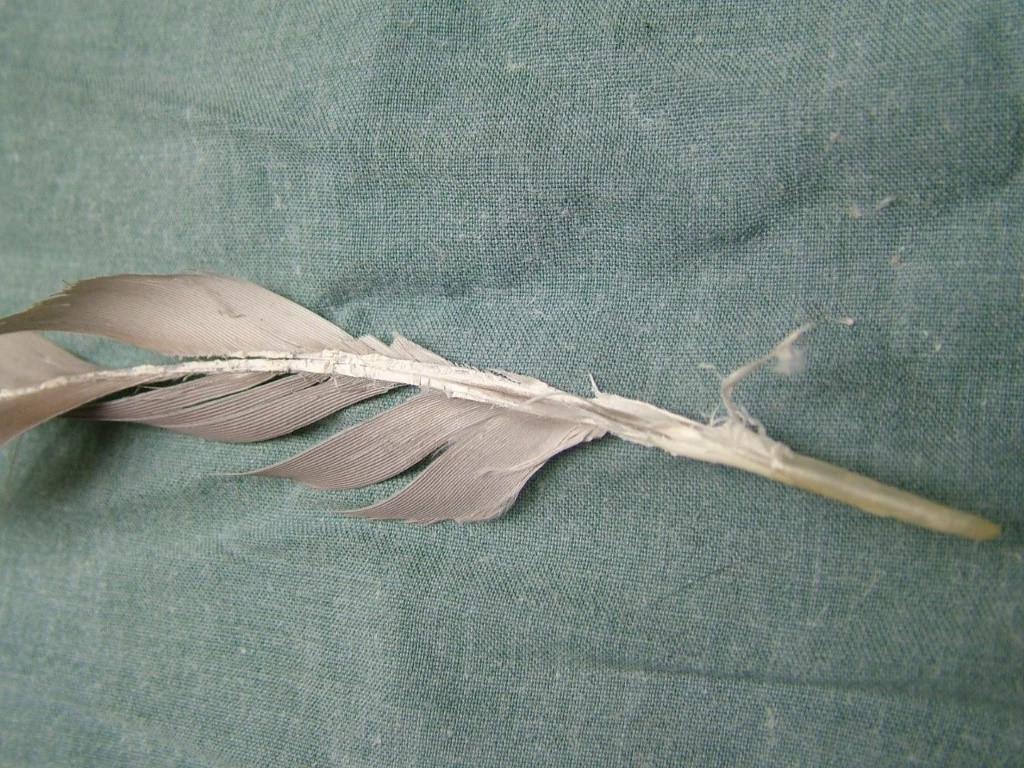
A feather damaged by feather damaging behaviour (feather barbering).
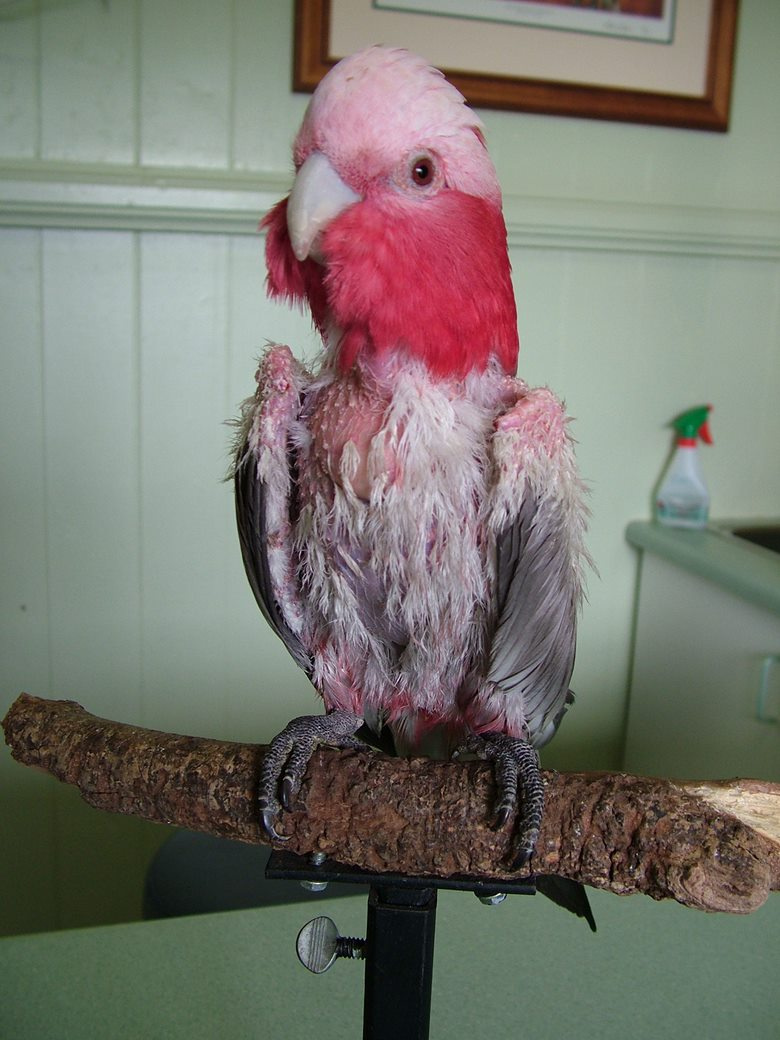
Galah affected by feather damaging behaviour (FDB).
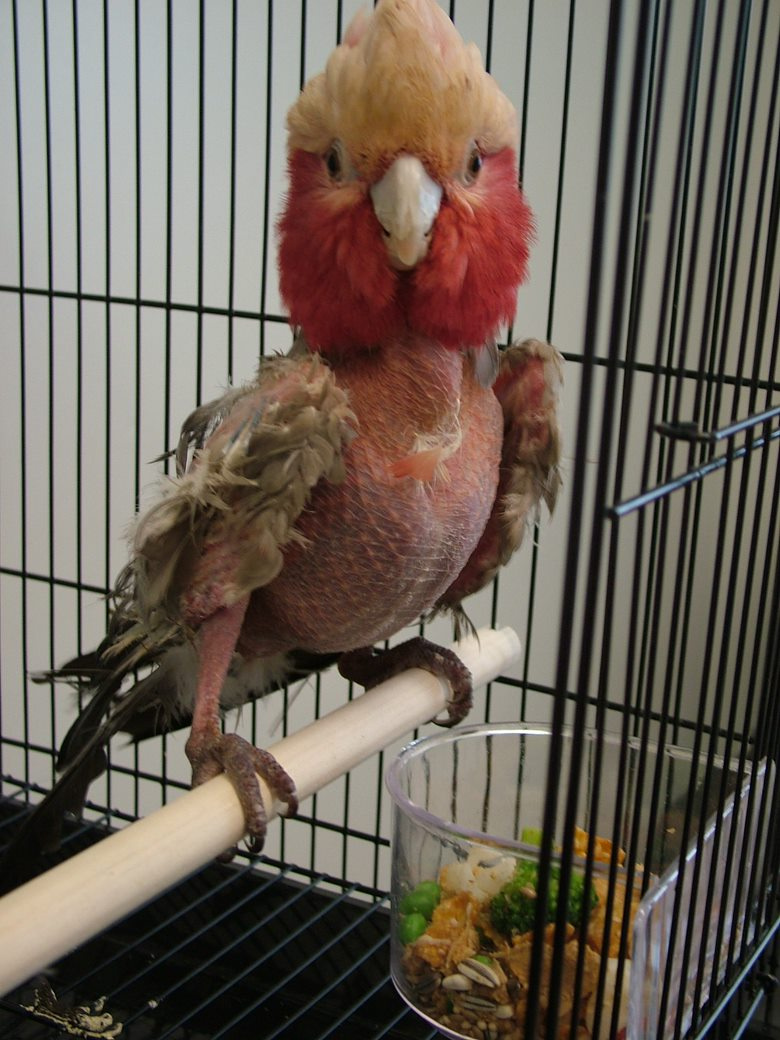
Galah affected by feather damaging behaviour (FDB).
Bibliography
Doneley B (2018) Avian Medicine and Surgery in Practice: Companion and Aviary Birds, 2nd ed. CRC Press

Registered Specialist in Bird Medicine
RSPCA Australia believes that captive-bred wild animals should not be kept in a home environment or for companion purposes unless the species has been clearly identified as being suitable for this purpose. It is important that animals living in a home environment can live a good life. This means providing for their physical health and ensuring opportunities to fully express their individual interests and experience good welfare. Inadequate care and husbandry are reported to contribute to common and serious welfare compromises in many captive wild animals living in home environments. For more information see our policy.
The reality is, however, that captive-bred wild animals are kept in home environments despite sometimes not meeting these criteria (e.g., some reptile and bird species). Because of this, the RSPCA has produced these articles on the care and welfare of a variety of commonly kept captive-bred wild animals. The aim is to help people better understand their animals as individuals and provide them with care that keeps them healthy and provides opportunities for positive mental experiences as much as possible in captivity.
Wild animals must not be taken from the wild to be kept as companion animals (pets).
Was this article helpful?

This work is licensed under a Creative Commons Attribution-NonCommercial-NoDerivatives 4.0 International License.