

What happens with male chicks in the egg industry?
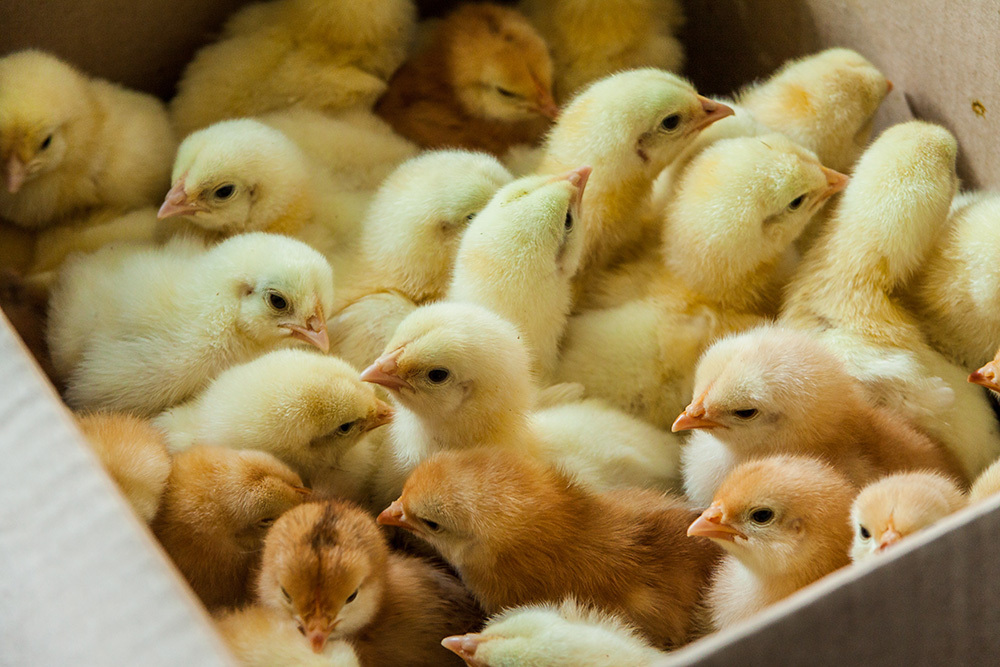
In the egg industry, male chicks have little commercial value and the vast majority are killed on the day they hatch. The routine killing of healthy male chicks poses both animal welfare and ethical concerns. Several methods for detecting and destroying the male embryos inside the egg before they hatch are commercially available (identifying male embryos is called in-ovo sexing), and the killing of day-old chicks in the egg industry should be phased out without delay.
Killing of day-old male chicks
Each year, around 6.5 billion male layer chicks are killed globally [1] on the day they hatch because they cannot lay eggs and are not suitable for meat production. This is because the breeds of chicken used by the egg industry have been strongly selected for egg production rather than muscle growth (meat), resulting in birds with very lean bodies.
In comparison, both male and female chicks in the chicken meat industry are raised for meat production because meat chickens are a different breed of poultry to layers and bred to grow large breast and leg muscle. Muscle growth is high for both male and female meat chickens, meaning that both sexes have commercial value.
Chick hatcheries breed one or the other type of chicken depending on which poultry industry they supply – eggs or meat. At hatcheries supplying the egg industry with layer hens, fertile eggs are incubated in industrial-sized incubators. Once hatched, the newborn chicks pass down a production line to be sexed and sorted. Sick or weak female chicks and all male chicks are separated from the healthy female chicks and then killed.
There are two methods used for killing day-old chicks in the egg industry [2,3]:
- Mechanical destruction, known as maceration, using a purpose-built macerator. During maceration, chicks are instantaneously killed using either rapidly rotating blades or instantaneously crushed using interlocking rollers.
- Gas killing using carbon dioxide or argon gas.
Both methods have advantages and disadvantages. While maceration is considered humane if performed using a well-designed, maintained and operated system [3,4], it is unpleasant to watch. Gas killing is a less confronting method but is not instantaneous and chicks may take 10-15 seconds to lose consciousness [2]. Carbon dioxide gas is known to be aversive to poultry and may cause suffering prior to death, especially if used at high concentrations.
While the routine practice of male chick killing is widespread around the world, it is not restricted to the egg industry. A similar practice occurs in the European foie gras industry, albeit on a smaller scale, where female ducklings are killed shortly after hatch because their livers are considered unsuitable for foie gras production [5].
Legislation
In Australia, the killing of day-old chicks is permitted under the Australian Animal Welfare Standards and Guidelines for Poultry. For the majority of states and territories that have not yet adopted the Poultry Standards, day-old chick killing is permitted under the older Model Code of Practice for the Welfare of Animals: Domestic Poultry.
Internationally, some European countries have taken the step to ban the killing of day-old male chicks, and others are considering or intending to ban this practice in the future (see Figure 1).
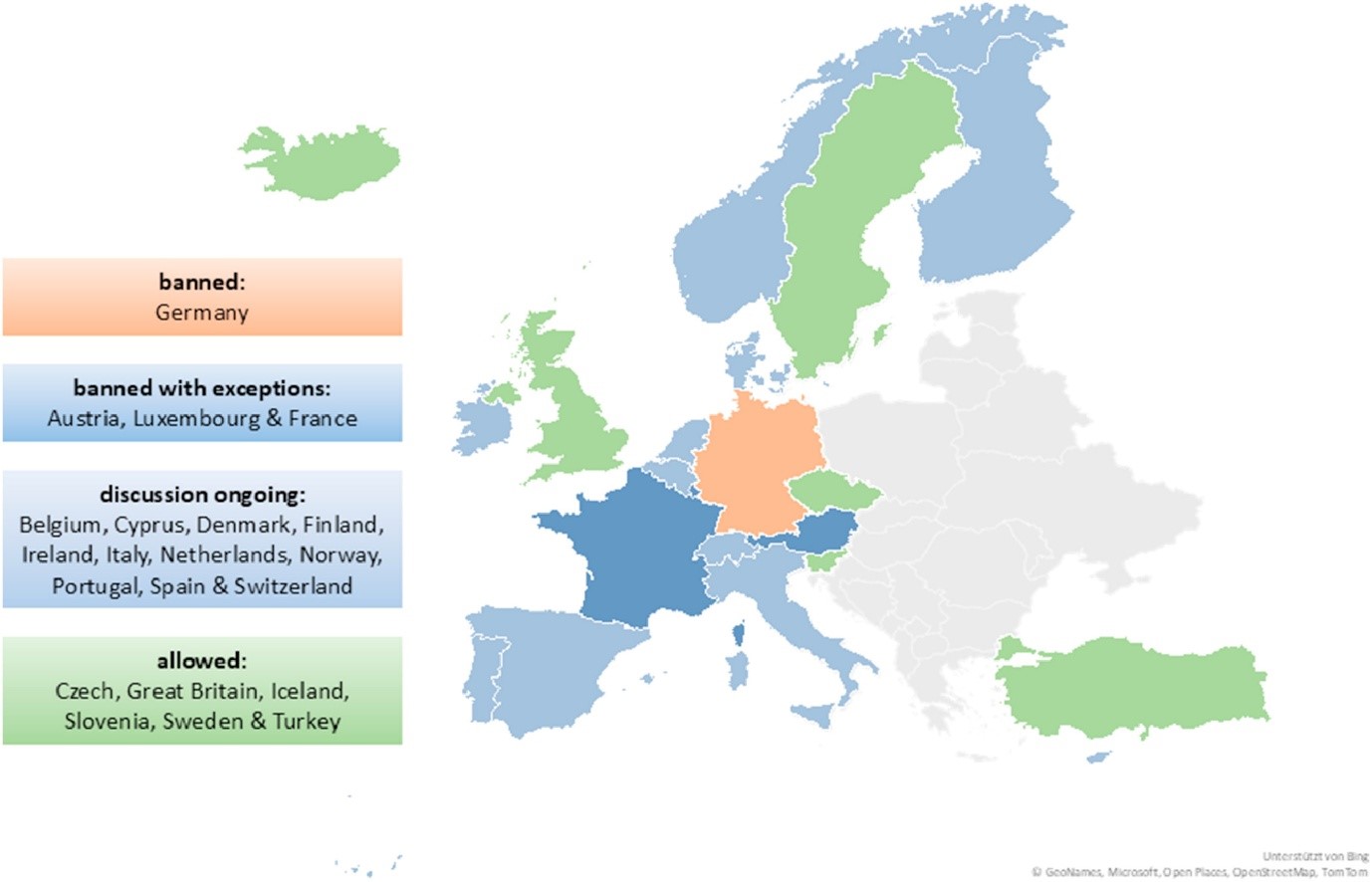
Figure 1. Legality of day-old chick killing in Europe (as at 2026) [8].
A 2026 survey of 230,000 people and organisations in Europe, found that 98% of respondents think male chick killing is ethically problematic, and 88% considered the use of alternatives to male chick killing to be a very urgent matter [6]. In an Australian context, a 2025 survey of 1000 people found that 73% of respondents agreed that the egg industry should find an alternative to the killing of day-old male chicks, and 66% indicated they were willing to pay a premium for eggs produced without male chick killing [7].
What are the alternatives?
The main alternatives to male chick killing are [9]:
- The use of in-ovo sexing to identify the eggs containing male embryos and destroy them before they hatch. See below for more information on this technology.
- Rearing male chicks to adulthood for meat production. This is not generally considered economically viable due to the long growth periods required and the small quantities of meat produced. However, see this company in The Netherlands for the exception to this rule.
- Using dual-purpose chicken breeds, where the females are used for egg production and the males are used for meat production. Dual-purpose birds are less efficient at food production than the specialised meat and egg-laying breeds and are generally not considered to be an economically viable alternative.
In-ovo sexing technology
In-ovo sexing provides a viable alternative to the killing of day-old chicks. This technology can determine which eggs contain male chick embryos, allowing these eggs to be removed from incubation and destroyed before they hatch. However, for in-ovo sexing to provide a humane alternative to male chick killing, it must be performed before the male chick embryo develops the capacity to experience pain and suffering.
Chicken eggs take 21 days to hatch. There is strong scientific evidence that chick embryos can experience pain by Day 17 of incubation, and some evidence that this may occur as early as Day 13 [1,10]. Therefore, the threshold for in-ovo destruction should be at least Day 16 of incubation, and ideally by Day 12, to avoid the potential for chick suffering during egg destruction. Currently, three of the four commercially available methods of in-ovo sexing can be performed at or before Day 12.
There are two main approaches to in-ovo sexing that are already being used commercially. One approach is to visually scan the embryo for physical differences that indicate sex using a range of technologies, e.g.:
- at Day 7, using spectroscopy (e.g. Omegga)
- at Day 12, using MRI (e.g. Orbem)
- at Day 13, using feather colour (e.g. Cheggy).
Another approach is to take a small sample of fluid from within the egg at Day 9 to analyse for biochemical differences that indicate sex (e.g. SelEggt).
Once in-ovo sexing has occurred, the eggs containing male chick embryos can be removed from incubation and used for other purposes such as processing into animal feed or utilised in laboratories.
While some technologies are providing commercially viable alternatives to male chick killing, others are still in the research and development phase (e.g. CSIRO/Hendrix collaboration using a biomarker protein to identify the male embryo) and research interest in this topic has increased substantially in recent years.
What is the RSPCA’s view?
The RSPCA continues to urge the egg industry to invest in and adopt alternatives that remove the need to kill day-old male chicks and avoid the potential pain and suffering associated with current killing methods. With ongoing research and innovation as well as commercial availability of alternative technologies, the killing of day-old chicks should be phased out without delay.
References
Petrik MT, Petrik JJ (2026) Onset of nociception and pain perception in chicken embryos – a review. World’s Poultry Science Journal, 1–10.
Underwood G, Andrews D, Phung T, Edwards LE (2021) Incubation, hatchery practice and the welfare of layer hens. Animal Production Science 61(10):867-875.
Humane Slaughter Association (2023) Code of Practice for the Killing of Chicks in Hatcheries.
American Veterinary Medical Association (2020) Guidelines for the euthanasia of animals: 2020 Edition.
Rochlitz I, Broom DM (2017) The welfare of ducks during foie gras production. Animal Welfare 26(2):135-149.
Innovate Animal Ag (2025) In-ovo sexing Australian consumer survey.
Stuff J, Goerlich VC, Becker S, Hillemacher S, Cheng L, Pu Q, Kuerten S, Huang R, Tiemann I (2026) Ban of day-old chick culling: Ethical concerns and challenges for policy, industry, and research. Journal of Applied Poultry Research 35(2):100668.
Coppola F, Paci G, Profeti M, Mancini S (2024) Stop culling male layer-type chick: An overview of the alternatives and public perspective. World's Poultry Science Journal 80(2):611-631.
Mace JL, Knight A (2025) Development of the capacity to suffer in embryos and chicks: A systematic review of relevant studies. Frontiers in Veterinary Science 12:1698528.
Was this article helpful?

This work is licensed under a Creative Commons Attribution-NonCommercial-NoDerivatives 4.0 International License.