
What happens to joeys when female kangaroos or wallabies are shot?
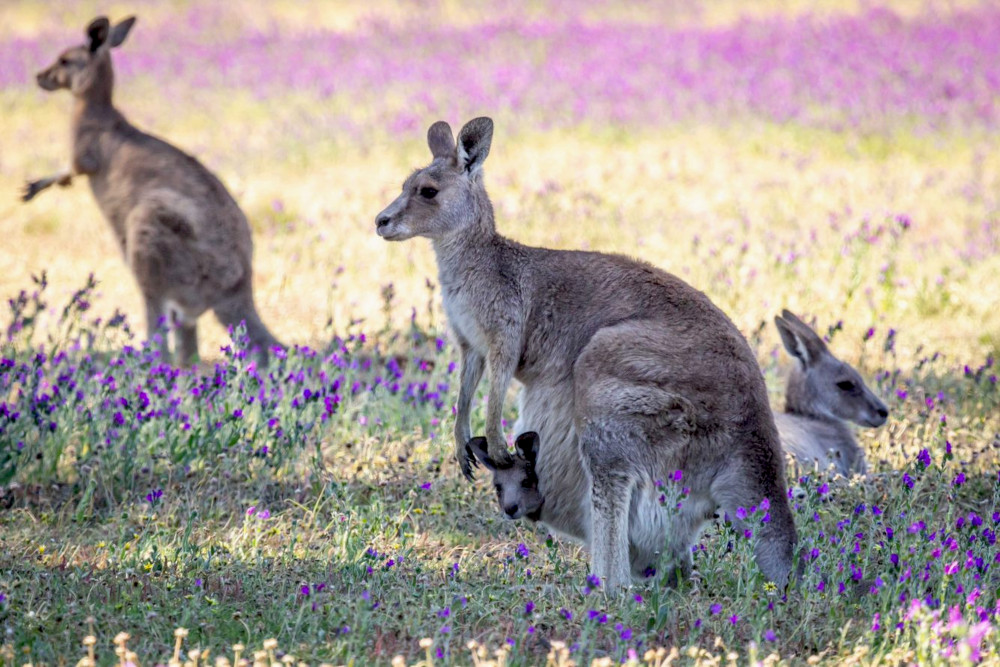
Kangaroos and wallabies are marsupials so their offspring (‘joeys’) are born at a very early stage of development and spend many months growing and developing further in their mother’s pouch. Once they are ‘young-at-foot’ (out of the pouch) they can still be dependent on their mother for food and protection for several more months. A number of kangaroo (and wallaby) species are shot in Australia for commercial harvesting and for other non-commercial reasons. When female kangaroos are shot it is highly likely they will have a dependent joey who is unavoidably impacted. Understandably, this creates substantial concern for the welfare of these joeys.
Regulation of kangaroo shooting
Both the commercial and non-commercial shooting of kangaroos must be carried out in accordance with the relevant National Codes of Practice (COP). For commercial shooters this is the Australian National Code of Practice for the Humane Shooting of Kangaroos and Wallabies for Commercial Purposes [1], and for non-commercial shooters it is the Australian National Code of Practice for the Humane Shooting of Kangaroos and Wallabies for Non-Commercial Purposes [2].
It is a requirement of both COPs that if a shooter kills a female kangaroo the pouch must be checked and any joeys (‘pouch young’) found must be promptly killed. Pouch young that are not killed will almost certainly die from dehydration, starvation, exposure or predation, which results in a prolonged, distressing, and inhumane death. Older, at-foot joeys that are weaned or suckle infrequently have some chance of survival without their mother, but this is dependent on age and environmental conditions including the availability and quality of food. Although they may be weaned, loss of their mother will have significant negative impacts including fear, anxiety and stress. Statistics on kangaroo shooting rarely include joey numbers, however at least 200,000 joeys die each year across Australia as a conservative estimate.
The commercial COP is now due for review and the non-commercial COP is more than a decade out of date. The requirements for joey management differ between the two codes with the commercial COP including detailed standard operating procedures and the non-commercial COP being insufficient in both detail and guidance. Neither COP requires training or competency testing with regards to the treatment, assessment and humane killing of joeys, however the commercial COP does require shooters to undertake shooting accuracy tests every 5 years.
Required methods and processes
The two COPs detail the approved methods for killing orphaned joeys, which differ for commercial and non-commercial shooters. Depending on the size and age of the joey, killing may be done by decapitation, a blow to the head, or neck dislocation. Larger young are killed by a shot to the head or chest. Shooters must confirm that the joey is dead. Research suggests that current methods used to kill joeys have the potential to be relatively rapid and humane when carried out by skilled and experienced commercial shooters [3], however, these methods require a high level of technical expertise and when carried out incorrectly are likely to result in severe suffering. To ensure that these methods are performed correctly it is essential that all shooters are trained, competency assessed and monitored to help minimise pain and suffering. However, there is currently no independent oversight of the treatment of orphaned dependent joeys for either commercial or non-commercial shooting. Kangaroos are also highly vulnerable to stress and can develop fatal myopathy - muscle wasting and organ failure - as a result of trapping, chasing or restraint [4], therefore the risks to welfare are not limited to direct killing methods.
Research has also been published on alternative methods for killing joeys, such as the use of penetrating captive bolts [5] however these are not yet included as approved killing methods in the COPs.
Reducing and preventing impacts on joeys
The non-commercial COP discourages shooters from targeting females with obvious pouch young or young-at-foot, although the commercial COP does not.
When the mothers are shot, some young-at-foot can flee and disperse. When this happens, it is unlikely they will survive unless they are already independent of their mothers. Humane killing of a joey in this situation is very challenging and, in some cases, prohibited as the commercial COP requires them to be stationary before being targeted.
One solution to this issue is to avoid the shooting of any female kangaroos or wallabies, and this policy was adopted several years ago by a number of commercial kangaroo harvesters. However, in terms of damage mitigation this approach does not appear to suppress population spikes and has been perceived by landholders as insufficient to control grazing impacts from kangaroos [6]. This led to increased targeting of female kangaroos by non-commercial shooters, which raises welfare concerns as they are not required to undergo training or assessment for shooting accuracy and there is less oversight of animal welfare, meaning lower confidence that animals will be killed humanely. Careful consideration needs to be given for alternatives to the lethal management of kangaroos and wallabies.
Improvements needed
Urgent improvements are needed to reduce the risks of poor welfare and suffering for orphaned joey kangaroos and wallabies. Statistics should be collected on the number of joeys impacted by both commercial and non-commercial shooting as well as adults. The introduction of mandatory training, competency assessment and animal welfare monitoring when shooting is carried out is also needed. Both of the current COPs require revisions and consolidation into a single, high-welfare code of practice to ensure consistent standards apply to all joeys. Consideration is also needed for best practice management of kangaroos and wallabies in general, with prioritisation for humane, non-lethal management methods and the development of strategies for positive co-existence of people with wildlife.
Relevant podcast
References
AgriFutures Australia (2020) National Code of Practice for the Humane Shooting of Kangaroos and Wallabies for Commercial Purposes. Commonwealth of Australia.
Commonwealth of Australia (2008) National Code of Practice for the Humane Shooting of Kangaroos and Wallabies for Non-commercial Purposes. Endorsed by the Natural Resource Management Ministerial Council.
McLeod S, Sharp T (2014) Improving the humaneness of commercial kangaroo harvesting. Final report for RIRDC Project No PRJ-004103. Rural Industries Research and Development Corporation.
Thompson GG, Thompson SA, Pusey A (2023) Poor welfare outcomes resulting from poor management decisions in a translocation of western grey kangaroos (Macropus fuliginosus). Pac Conserv Biol 29:130–40.
Sharp TM, McLeod SR, Gibson TJ (2026) Behavioural and electroencephalographic assessment of captive-bolt stunning in kangaroo pouch young. Anim Welf 35:e20.
McLeod S, Sharp T (2020) The Australian kangaroo industry male-only harvesting, sustainability and an assessment of animal welfare impacts. AgriFutures Australia.
Was this article helpful?

This work is licensed under a Creative Commons Attribution-NonCommercial-NoDerivatives 4.0 International License.