

How do I keep my chickens safe in my yard?
There are many hazards in most backyards. Some are so commonplace that we often fail to recognise them as dangers. Others are very obvious, and these often distract us from less obvious hazards. The trick to minimising these hazards is to try to think and see things just like a chicken.
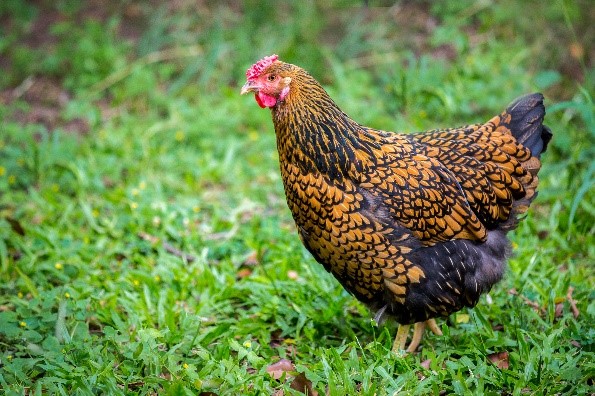
Photo credit: Sarah Burke.
The following are some of the more common hazards that can affect your chickens.
Predators
Whether kept in confinement or free-range, chickens are at risk of attack from predators large and small. These predators can be airborne (hawks, owls, falcons, and even eagles); in the trees around your coop (possums and snakes); or in the yard (dogs, cats, rats, and mice). Let’s not forget small children, who while meaning no harm, may chase your chickens, who then end up hurting themselves.
Your coop and yard should be able to withstand an assault from many different directions. Some suggestions for protecting your chickens are:
- Lock the chickens in their coop at night, even if they are free range during the day. Chickens are intelligent and love to roost in the same place every night. They will come home around the same time at the end of the day and can be locked up for the night.
- Lay down wire mesh – preferably small sized and tough – on the ground around the coop and buried under the floor of the coop. Spread dirt over it and allow grass to grow through it so that the chickens are not walking on it as, if exposed, it could hurt their feet. The wire will help to stop burrowing/digging animals such as rats, mice, and dogs digging through the wire and into the coop.
- Remove any overhanging tree branches that can allow snakes and rats to ‘drop in’ for a visit and feed. Make sure the coop is fully roofed, and any access points are blocked up.
- Make sure your fences are secure against the neighbour’s dogs or other unwanted visitors.
- Never assume your own dog will not chase a running chicken.
- Always check your coop perimeters weekly for signs of damage.
- Having a rooster with your hens (if allowed by the local council) uses their natural protective instincts to chase away predators or warn the hens of aerial predators such as hawks.
Poisons and medications
Be safety conscious about garden poisons, rat baits, livestock medications, or even your own medications. Keep in mind the effects of secondary poisoning – rodents and insects that have been poisoned are readily consumed by chickens, and this can result in the illness or death of the chickens.
Poisonous plants
There are a number of plants that we grow in our garden, either as decorative plants or for eating, that may be poisonous to chickens (especially in dry weather when garden plants are often heavily watered). Make sure you research the plants you are growing and, if any are dangerous to your chickens (or other pets), remove them or make sur your chickens and pets cannot get to them.
Glass, wire, and nails
Chickens like to peck at shiny objects and will often gulp them down without hesitating. This can lead to an accumulation of hardware in the bird’s gizzard. This can lead to either obstruction or ulcerations of the gizzard, or even lead poisoning.
Make sure you clean up well after working in the yard and pick up any stray rubbish you see.
Open water
Chickens cannot swim well and are at risk of drowning if they cannot easily get out of water. So open bodies of water such as water troughs, ponds, swimming pools, etc., pose very real threats to their wellbeing. Make sure that you either prevent access to the water, or place bricks etc., in water troughs the chickens can stand on to get out of the water.
Table scraps
While chickens are great for helping us dispose of leftover food, there are some foods that we should never give our chickens. These foods include:
- chocolate
- caffeine
- alcohol
- raw dried beans
- mouldy produce
- avocados
- salty food
And finally, let’s not forget small children, who while meaning no harm, may chase your chickens, who then end up hurting themselves.
Bibliography
Colville-Hyde A, Poland G (2019) Husbandry. In: BSAVA Manual of Backyard Poultry Medicine and Surgery. British Small Animal Veterinary Association, pp 27–38
Rosenbaum M, Greenacre C (2021) Toxicology. In: Greenacre C, Morishita T (eds) Backyard Poultry Medicine and Surgery: A Guide for Veterinary Practitioners. pp 368–380

Registered Specialist in Bird Medicine
RSPCA Australia believes that captive-bred wild animals should not be kept in a home environment or for companion purposes unless the species has been clearly identified as being suitable for this purpose. It is important that animals living in a home environment can live a good life. This means providing for their physical health and ensuring opportunities to fully express their individual interests and experience good welfare. Inadequate care and husbandry are reported to contribute to common and serious welfare compromises in many captive wild animals living in home environments. For more information see our policy.
The reality is, however, that captive-bred wild animals are kept in home environments despite sometimes not meeting these criteria (e.g., some reptile and bird species). Because of this, the RSPCA has produced these articles on the care and welfare of a variety of commonly kept captive-bred wild animals. The aim is to help people better understand their animals as individuals and provide them with care that keeps them healthy and provides opportunities for positive mental experiences as much as possible in captivity.
Wild animals must not be taken from the wild to be kept as companion animals (pets).
Was this article helpful?

This work is licensed under a Creative Commons Attribution-NonCommercial-NoDerivatives 4.0 International License.