

Where can I keep my chickens?
Council restrictions
The rules and regulations for keeping chickens vary depending on your local council. Many city councils allow you to keep a certain number of chickens (often five) without a permit, while rural councils are often more lenient. City councils often impose other restrictions; e.g., to minimise noise (no roosters, guinea fowl, or peacocks), a minimum distance from the coop to your fence or the neighbours’ house, and good hygiene practices (to prevent flies, rats, and mice becoming a health hazard to you or your neighbours).
Regardless of where you live, you should contact your local council for up-to-date information on any restrictions or regulations that may apply to keeping chickens in your area.
Positioning the coop and run in your yard
The coop and run should be in a sheltered spot where your chickens can spend time outside, while still having access to shade from the sun and shelter from the wind and rain. Ideally it should be open on the northern aspect to allow the sun to dry out the coop and run, but shaded to protect from temperature extremes. Look at where your prevailing winds come from and shelter the coop and run on that side.
Free range or confined to a run?
To keep your birds happy, it is important to find a balance between giving them time to free range and keeping them confined to keep them safe and limit damage to your garden. Backyard chickens who get the chance to free range are happier, healthier, and lay more eggs. But if you are in suburbia, you may need the protection of an enclosed run, rather than allowing your chickens to free range. When planning the construction of a chicken run, ensure that predators are excluded.
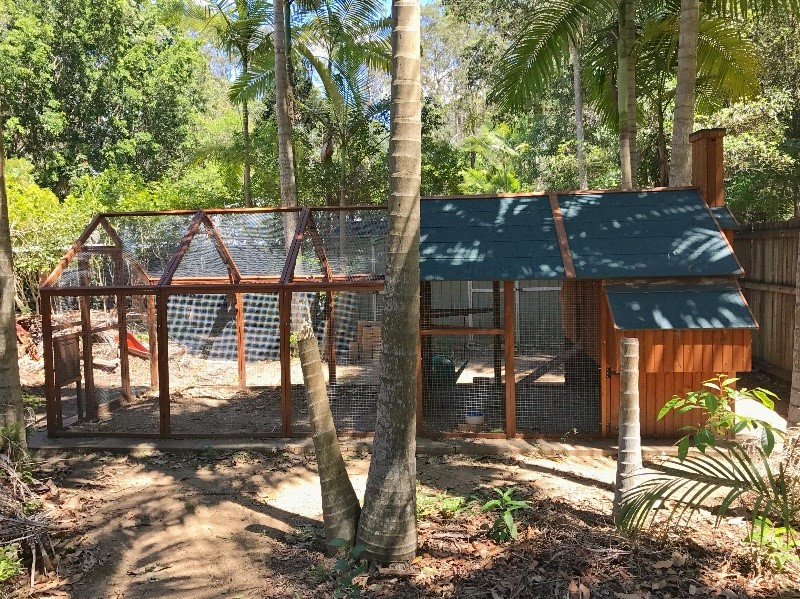
Example of a backyard chicken enclosure with a coop and an external run. The chickens housed here also had free range of the fully chicken-proof fenced garden during the daytime.
What about mobile pens?
An alternative to a fixed position coop may be a mobile pen (e.g., a chicken tractor). Mobile pens are usually a small coop and run that can be moved from one spot to another every day. This prevents overgrazing and damage to one spot in the yard.
How big an enclosure?
Ideally, you want to have the largest coop and run you can have. The size of the chicken run depends on the space available and that, in turn, may determine the breed and number of chickens that you can keep. If you only have a limited space, then considering a bantam breed (e.g., Pekins or Silkies) could be your best option.
Bibliography
Colville-Hyde A, Poland G (2019) Husbandry. In: BSAVA Manual of Backyard Poultry Medicine and Surgery. British Small Animal Veterinary Association, pp 27–38
Karcher D (2021) Basic housing and management. In: Greenacre C, Morishita T (eds) Backyard Poultry Medicine and Surgery: A Guide for Veterinary Practitioners. John Wiley & Sons, Inc, pp 45–55

Registered Specialist in Bird Medicine
RSPCA Australia believes that captive-bred wild animals should not be kept in a home environment or for companion purposes unless the species has been clearly identified as being suitable for this purpose. It is important that animals living in a home environment can live a good life. This means providing for their physical health and ensuring opportunities to fully express their individual interests and experience good welfare. Inadequate care and husbandry are reported to contribute to common and serious welfare compromises in many captive wild animals living in home environments. For more information see our policy.
The reality is, however, that captive-bred wild animals are kept in home environments despite sometimes not meeting these criteria (e.g., some reptile and bird species). Because of this, the RSPCA has produced these articles on the care and welfare of a variety of commonly kept captive-bred wild animals. The aim is to help people better understand their animals as individuals and provide them with care that keeps them healthy and provides opportunities for positive mental experiences as much as possible in captivity.
Wild animals must not be taken from the wild to be kept as companion animals (pets).
Was this article helpful?

This work is licensed under a Creative Commons Attribution-NonCommercial-NoDerivatives 4.0 International License.