

What are the welfare issues with elephants in Australian zoos?
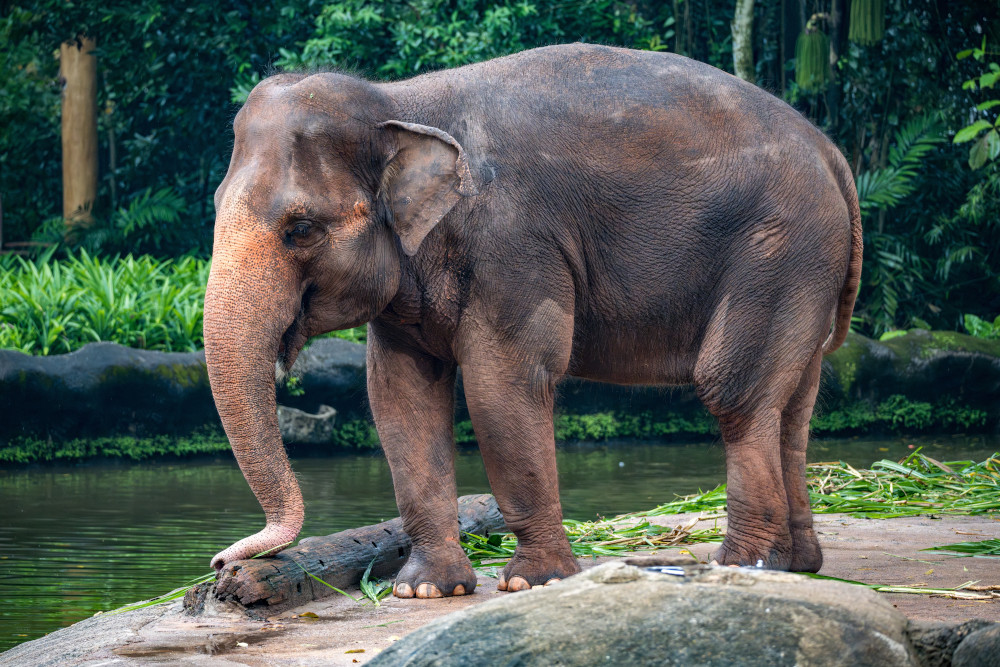
It is essential that animals kept in zoos receive the highest standards of care that meet their behavioural, social and physiological needs, with documented animal management plans, and minimum enforceable husbandry standards. Recently in Australia, several elephants living in confined captive environments were transferred to large open-plain facilities, opening up greater opportunities to improve their welfare. However, given that elephants have complex needs, meeting all their needs in captivity is very challenging.
Natural behaviour and needs of elephants
Elephants are intelligent, emotionally sensitive, and socially intricate animals whose wellbeing depends on expressing a wide range of natural behaviours [1]. In the wild, elephants live in tightly knit matriarchal herds that provide safety, learning opportunities, and emotional support, especially for young elephants in the herd. Family units typically consist of two to 10 adult females, while adult males tend to be more solitary [1]. Within these groups, elephants maintain relationships through touch, scent, vocal communication, and even seismic signals transmitted through the ground [2]. Daily life in the wild is dominated by foraging involving travelling vast distances to locate food and water – and by behaviours that maintain physical health such as swimming, mud wallowing, and dust bathing [1]. These behaviours are integral to their physical and psychological wellbeing and serve as benchmarks for assessing welfare in captive environments.
Welfare challenges in zoos
Elephant welfare can be assessed by applying the Five Domains Model, encompassing consideration of nutrition, environment, health, behavioural interactions, and mental state [3]. Optimum welfare requires that elephants are healthy, receive a nutritionally balanced diet, and are able to engage in natural behaviours important to them within environments that promote comfort, autonomy, and positive mental states. Captivity, however, poses inherent challenges to meeting these requirements. Limited space restricts locomotion and exploration, while artificial herd structures can cause social tension [1]. Monotony and lack of stimulation can reduce behavioural diversity and lead to frustration or apathy [1]. Physically, elephants in captivity are vulnerable to obesity, as well as foot and joint problems caused by hard substrates and restricted movement, illustrating how the physical environment is directly linked to both health and mental wellbeing [1].
Indicators of elephant welfare in zoo settings include frequency of stereotypies (repetitive behaviours with no obvious goal or function that are associated with stress, frustration, or poor welfare), the nature and level of behavioural activity (e.g. resting and night behaviour), and qualitative assessment of an animal’s demeanour (such as depressed, fearful, engaged, distressed, relaxed, agitated, frustrated, wary and playful) [4]. Captive elephants who display abnormal or stereotypic behaviours such as pacing, swaying or depressive states; reproductive irregularities related to stress and obesity; and high infant mortality have compromised welfare [1].
Modern zoos have shifted towards larger and more naturalistic environments such as open-plain habitatsmore physical space and greater variation and complexity [5]. Enrichment programs have also become central to welfare management, providing opportunities for dusting, mud bathing, and foraging to promote choice and engagement [1]. Nutritional management which includes high-roughage diets and foraging-based feeding systems help support digestive health and prevent obesity [1].
Open-plain zoos in Australia
In Australia, a move towards open-plain, semi-captive zoos provides welfare and conservation benefits. Facilities such as Taronga Western Plains Zoo in Dubbo, Monarto Safari Park in South Australia, and Werribee Open Range Zoo in Victoria now house most of the nation’s elephants. However, a number of elephants continue to be retained in a more confined environment in two zoos, one in Queensland and the other in Western Sydney (this has very restricted space) – these are not considered to be open-plain. Open-plain zoos have more expansive settings that provide greater space, natural substrates, and environmental complexity, allowing elephants to move more freely, form stronger social bonds, and express a wider range of natural behaviours [6]. Open-plain zoos also report higher reproductive success, fewer stillbirths, and longer life spans, although these aspects should be viewed with caution in relation to indicating positive overall health and welfare of captive elephants. The quality of life is more important than longevity. Open-plain facilities also provide opportunities for meaningful public engagement through guided ‘elephant experiences’ and educational encounters that emphasise enrichment and conservation.
Persistent limitations to elephant welfare within zoos
Despite these advancements, open-plain zoos in Australia continue to face limitations in replicating the full ecological and social conditions of elephants in the wild. Even within large, open environments, it remains difficult to mirror the complex social structures and long-distance ranging behaviours that are integral to elephant societies [1]. These constraints continue to prompt ethical questions about whether captivity, regardless of its space or enrichment, can truly fulfil the species’ cognitive, social, and psychological needs [1]. Proponents argue that elephants in zoos contribute to conservation, education, and welfare research, but critics maintain that such justifications weaken when natural social dynamics and behaviours cannot be fully expressed [1]. Moreover, there are ethical considerations for breeding elephants in captivity, especially given the welfare implications, and should only be considered justifiable where natural populations can be expanded and without compromising individual elephant welfare. Ongoing research is needed to identify ways to effectively measure the welfare of elephants, even within open-plain settings, to ensure that elephants currently living in captivity can enjoy a good life.
References
Doyle C, Rally H, O’Brien L, Tennison M, Marino L, Jacobs B (2024) Continuing challenges of elephant captivity: the captive environment, health issues, and welfare implications. PeerJ 12:e18161.
Jacobson SL, Plotnik JM (2020) The importance of sensory perception in an elephant’s cognitive world. Comparative Cognitive Behavioral Review, 15:131-148.
Mellor DJ, Reid CSW (1994) Concepts of animal well-being and predicting the impact of procedures on experimental animals. In Improving the Well-Being of Animals in the Research Environment; Australian and New Zealand Council for the Care of Animals in Research and Teaching (ANZCCART): Glen Osmond, SA, Australia, pp. 3–18.
Yon L, Williams E, Harvey ND, Asher L (2019) Development of a behavioural welfare assessment tool for routine use with captive elephants. PLoS ONE 14(2):e0210783.
Scott NL, LaDue CA (2019) The behavioral effects of exhibit size versus complexity in African elephants: A potential solution for smaller spaces. Zoo Biology 38(5):448–457.
Hacker CE, Miller LJ, Schulte BA (2018) Zoo elephants: Space, enrichment, and welfare. Animal Welfare 27:55-65.
Was this article helpful?

This work is licensed under a Creative Commons Attribution-NonCommercial-NoDerivatives 4.0 International License.