

What is the RSPCA’s view on dominance dog training?
Many of the assumptions that form the basis of dominance dog training are flawed and are often harmful to dogs and the human-animal bond. The RSPCA supports current evidence-based training programs that are reward-based and designed to promote the development and maintenance of desirable behaviours using natural instincts and positive reinforcement.
In recent years, there has been resurgence in popularity of dog training methods that promote “dominance” models of dog behaviour. Dominance models suggest that wolves live in hierarchical packs with the alpha wolf at the top and that dogs evolved from wolves and also live in hierarchical packs and see us (humans) as part of their pack. Dominance theory assumes that most unwanted behaviour such as aggression is due to the dog trying to be ‘dominant’ or wanting to be the alpha dog in the pack. Therefore, dominance theory suggests, that the way to solve many behavioural problems, such as aggression, is to establish dominance as pack leader over the dog.
However, many of these assumptions are flawed and are often harmful to dogs and the human-animal bond. Much of the initial research about wolf behaviour was conducted by studying captive wolves. This is because wild wolves tend to avoid humans and were difficult to study. It was these studies that generated the idea of ‘packs’ with the alpha male and female breeding pair at the top of the hierarchical structure. However, in this false environment wolves could not disperse and escape from confrontation with other wolves, so relationships developed that are not necessarily reflected in more natural wolf groups. More recent studies of natural wolf groups show that they tend to live in families. The group usually consists of the breeding pair (mother and father wolves), the current litter, and possibly juveniles from one or two previous litters. Dominance contests in such packs are rare, and the breeding pair is able to maintain group harmony without aggression.
Most scientists accept that dogs evolved from wolves, or they had a common ancestor, but dogs are not wolves. They are different anatomically, physiologically, behaviourally, and socially. The biggest difference between wolves and dogs is their ecological niche. Wolves, as a rule avoid humans whereas dogs have evolved to live near, and now with, humans.
It is now widely recognised by animal behavioural specialists that dogs who use aggression towards humans or other dogs are not trying to be ‘dominant’. Rather, the aggression is usually the result of social confusion, frustration, fear, anxiety, or learning. Dogs may use aggression as a means to control situations in which they feel frustrated, fearful, or anxious. Some dogs are unable to navigate certain social and interactive demands placed upon them without showing aggression or reactivity. With repeated exposure to such situations dogs can learn that aggression ‘works’ and are more likely to use aggression to control similar situations in the future. If your dog is showing aggression, it is advisable to seek help from a qualified applied animal behaviourist or veterinary behavioural specialist.
The ‘dominance’ model for dog behaviour poses serious dog welfare problems. Dominance models may use aversive training techniques such as “alpha rolls”, staring the dog down or other confrontational methods and punishment which can cause fear, pain, and distress to dogs. Research has found that dogs trained with two or more aversive training methods are more pessimistic in a cognitive bias test [1]. In addition, these methods generally do not address the underlying cause of the unwanted behaviour which is why they are often unsuccessful [2]. In fact, dominance training methods are not scientifically proven to be effective.
Aversive methods may also increase the dog’s underlying fear and anxiety which can actually make the unwanted behaviour much worse. Aversive methods can also reduce the quality of the relationship between the owner and the dog, and they can place the owner at serious risk of physical injury.
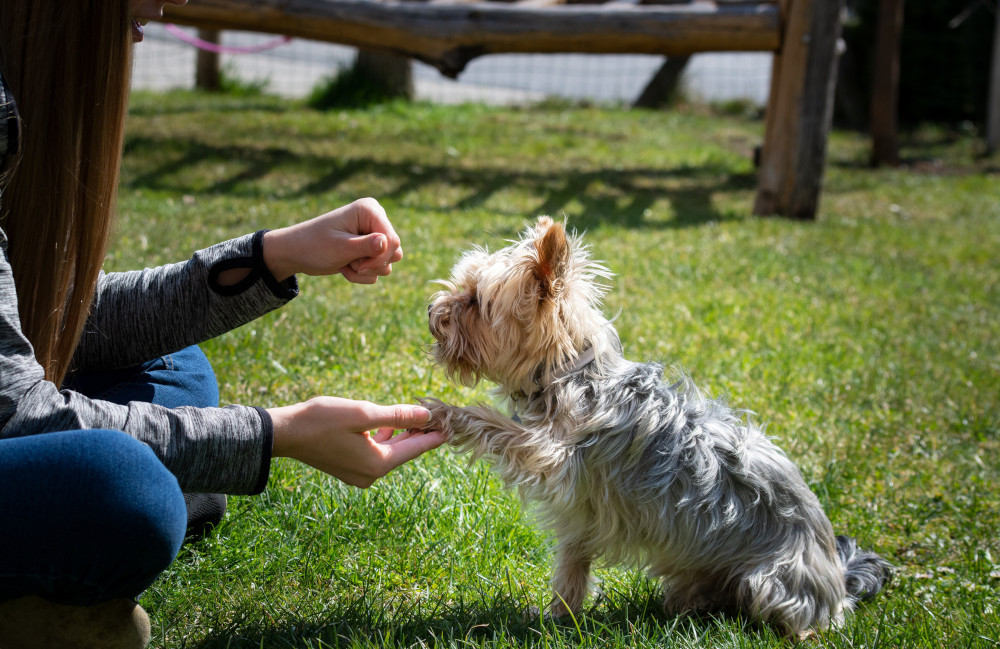
Image credit: Pezibear (Pixabay)
When trying to change behaviour, try to think about the behaviours you would like your dog to perform instead and focus on rewarding only the responses that lead to those desired behaviours. This might include sitting rather than jumping on guests or chewing on a toy rather than your favourite pair of shoes. This approach revolves around positive reinforcement (i.e., rewarding behaviour that you like). Rewards, also called reinforcement, can be food, toys, or verbal praise – anything your dog values and will ‘work’ for.
Simultaneously, you also need to ensure that rewards for unwanted behaviour are removed. So, keep those shoes out of reach and try wherever possible to avoid any situations or triggers for unwanted behaviours.
The RSPCA strongly advocates that dogs should be trained using methods that are humane, low-stress, force-free, reward-based, and prioritise positive reinforcement. Training should be founded on current evidence-based understanding of how animals learn, and must not cause injury, pain, suffering, or distress to the animal. Reward-based training approaches carry the lowest risk of causing harm, are effective, encourage positive and engaging emotions, and build positive associations between the animal and handler.
The RSPCA is opposed to the use of aversive equipment and methods to train and control companion animals as they are inhumane, can increase risk of injury to both animals and people, can have short and long-term negative impacts on the physical and mental health of the animal and their relationship with people, may result in learning difficulties, and risk the development of ongoing problem behaviours.
References
Casey RA, Naj-Oleari M, Campbell S, Mendl M & Blackwell EJ (2021) Dogs are more pessimistic if their owners use two or more aversive training methods. Scientific Reports 11(1):19023.
Yin S (2007) Dominance versus leadership in dog training. Compend Contin Educ Vet 29(7):414-417.
Was this article helpful?

This work is licensed under a Creative Commons Attribution-NonCommercial-NoDerivatives 4.0 International License.