

What are the welfare issues with rodeo bucking horses?
Bucking events involving horses are seen at most rodeos. Although horses naturally buck, the type of bucking resulting from the use of a flank strap and spurring is physically extreme, with horses displaying many behaviours indicative of experiencing pain, fear and/or stress. The RSPCA advocates for all rodeo events, including those involving bucking horses, to be prohibited on welfare grounds.
Horse behaviour
Horses are a prey species who rely upon running to escape a threat such as fear (perceived predator attack) and stress. When they are trapped and forced to endure painful or stressful situations, they may buck, kick and bite to try to escape, or they may freeze, tremble and may lose their footing causing a stumble or fall.
Voluntary bucking can be a play behaviour in horses, but repeated bucking in response to a perceived threat or predator is usually a last resort behaviour and is avoided unless the horse perceives there is no other option. This is because bucking carries the risk of injury to the horse and because it uses up considerable energy, which is better directed to fleeing. Some horses who become overwhelmed by repeated uncontrollable stressful situations will literally freeze (known as learned helplessness) where they may appear to be calm, but they stop trying to escape as they have learned that they can’t. Horses who freeze may fall over and seemingly refuse to get up even when hit or shouted at and when they do rise, they may appear dazed and unsteady on their feet. Escape behaviours and less commonly freezing behaviour can be observed in bucking horses at rodeos.
Studies of behaviours of horses used in other sporting activities (e.g. dressage, showjumping, barrel racing etc) have identified several indicators of pain, fear or stress, which have been referred to as conflict behaviours because the horse doesn’t know how to escape the pain, fear and stress they are experiencing [1,2,3,4].
Several of these have also been observed in bucking horses including:
- Escape attempts (rearing, bucking, baulking, kicking)
- Open mouth with or without tongue protrusion
- Tail swishing
- Flared nostrils
- Head tossing
- Neck wringing (neck twisting in a fluid motion)
- Eye white (increase in amount of the white of the eye showing)
- Falling
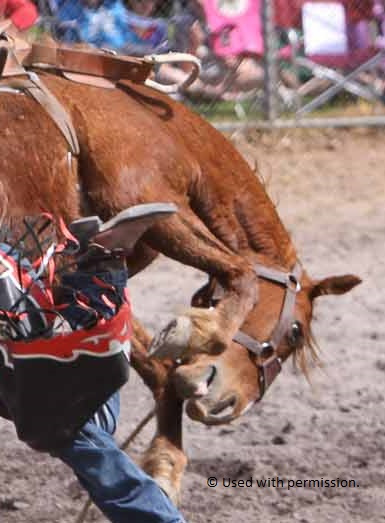
Image of bucking horse displaying eye white, open mouth and extreme body contortion.
Animal welfare
Flank strap
There are two types of bucking events at rodeos – bareback bronc (includes the use of special rigging, not a saddle) and saddle bronc (includes the use of a special saddle) with each involving the use of a flank strap (a wide strap of leather covered in sheep skin) applied to the horse, and spurs worn by the rider. These events involve releasing a horse from a chute into the arena, where they buck frantically to stop the pain and irritation caused by the flank strap. In the process, they may dislodge the rider because the bucking is very intense. The goal for the rider is to stay on the horse for eight seconds. As the horse leaves the chute the flank strap which goes around the body of the horse just in front of the back legs (including the sensitive underbelly) is rapidly tightened which makes the horse buck. After the rider dismounts, and the flank strap is removed, bucking ceases quickly in most but not all horses. Although, rodeo supporters state that the flank strap only causes discomfort, the definition of pain includes any experience which is perceived as actual or potential tissue damage including discomfort or irritation [5]. Thus, any form of discomfort caused by a flank strap should be considered as pain.
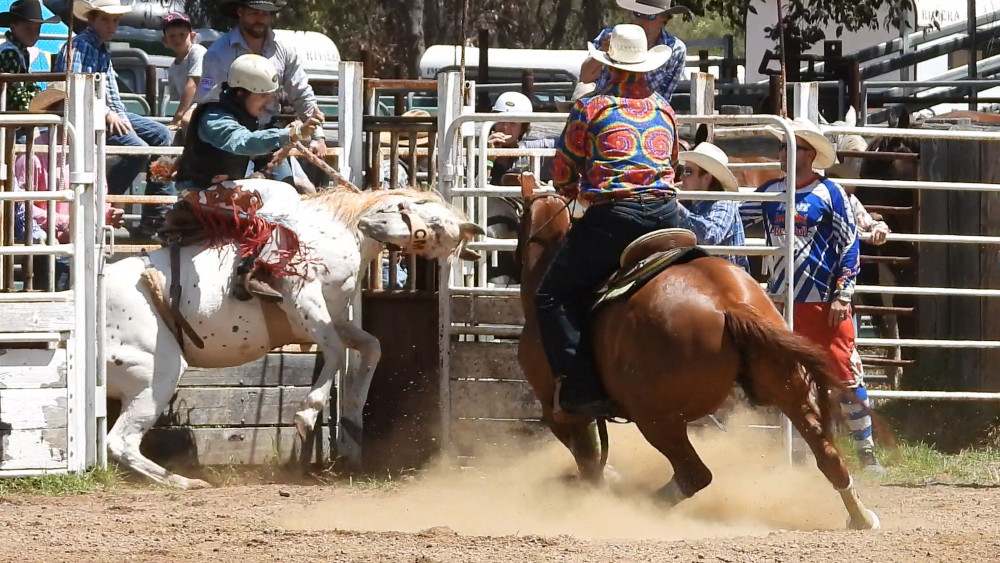
Extreme neck twisting after the flank strap is tightened as the horse leaves the chute.
Although the rodeo industry claims that bucking horses are trained to buck on cue, this is strongly challenged evidenced by the continued use of flank straps. In normal horse training, horses learn to behave in certain ways to escape or avoid pressure from things like bits and spurs because when they show the desired behaviour, those pressures are removed. This is not what bucking horses experience because no matter how high or hard they buck, the pain caused by the flank strap remains. It is uncontrollable and there is no way for the horse to escape the impacts of the strap until the rodeo staff remove it. Furthermore, animals who experience fear and stress have a reduced capacity to learn [6].
The flank strap is very different to a regular girth (strap) attached to a saddle, where horses can become accustomed to it through appropriate training. Because of where the flank strap is applied to the horse - tightly across sensitive skin, the horse never gets used to it and will therefore buck each time they feel it. Signs of fear, pain or stress provide further evidence that it causes negative physical and mental impacts. The industry argues that the flank strap does not cause pain and instead works like a cue for the horse to buck, similar to a verbal cue to a dog to sit. If this was the case, then it should be possible to train horses to buck in response to a non-harmful cue, however there are no indications that the industry is exploring this option.
When training animals, this should be done in a calm and gentle manner because this reduces risks to the horse as well as the handler(s). However, many horses display behaviours indicative of fear and/or stress whilst in the chute which is why rodeo staff may use neck ropes or halters to control the horse inside the chute. A USA study reported over 70% of horses baulked during loading into the chutes [7]. Other signs indicative of fear and stress were also observed indicating they were frightened in the chute, before any tack or the flank strap was applied.
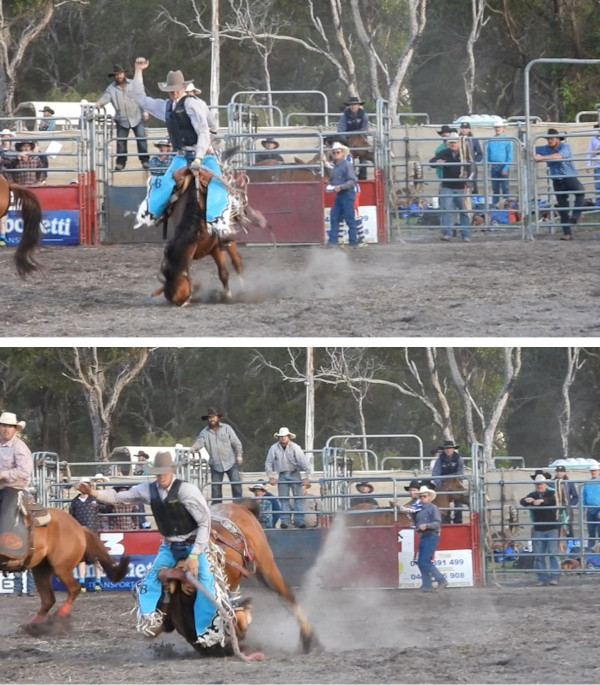
Horse losing footing and heavily somersaulting head first into the ground.
Warning: This footage is graphic and may cause viewer distress.
Spurs
In addition to the flank strap, bucking horses are repeatedly exposed to being kicked by the rider’s spurs, which are made of metal including the moveable rowel of the spur (at the back of the spur) which has narrow metal points arranged in a star-type pattern. The rider is scored on how aggressively they spur the horse - the greater the aggression, the higher the score. Riders are required to repeatedly hit the horse’s neck with their spurs and then drag them across the skin with such force that distortion of the skin may be visible. Some rodeo rules also allow the judge to call for spurring of the belly by the rider if a horse falls in the chute after the gate is opened [8]. The industry says that because the rowels of the spurs are free moving and the ends of the spurs are not sharp, spurring does not harm the horse. Horses have a high number of nerves in their skin, which allows them to detect even the pressure of a fly landing on them, and so kicking, raking, and rolling with spurs will cause inescapable pain and stress. Soft tissue damage is inevitable due to the force with which the spurs contact the skin resulting in bruising and ongoing pain. A study of UK equestrian riders found that spur use in regular riding, which did not even involve the kinds of deliberate high velocity impacts used in rodeo, was associated with skin lesions, hair loss and bruising [9]. This suggests rodeo horses could be at even higher risk of injury from spur use in rodeo due to the spur design and the forces involved.
Use of electric prodders
Electric prodders may be used on bucking horses in some states and territories to make them exit the chute if they don’t voluntarily leave or don’t leave quickly enough. Electric prodders or electric jiggers cause pain and create fear and stress in animals and should never be used on horses or young animals. Electric prodders are mainly used for moving farm animals, although this is being increasingly questioned as their use is not justified if animals are handled in a calm, gentle manner. However, in several jurisdictions including WA, NSW, SA and NT, an electric prodder can be used on rodeo bucking horses. An Australian study has assessed the adequacy of current laws in different jurisdictions in relation to safeguarding the welfare of rodeo bucking horses with the authors calling for legal reform to prohibit the use and/or possession of an electric prodder near any horse at a rodeo [10].
Pain, fear and lack of choice
Horses may be at risk of injury to the head, neck, shoulders, ribs, legs and back due to escape attempts in the chute, collision with railings or falls, as well as injuries associated with extreme bucking. Some horses are so overwhelmed that they may stumble, whilst others may somersault hitting the ground head-first and in some documented cases, horses have suffered catastrophic limb fractures and spinal injuries that result in them having to be euthanased [11]. Horses who are unable to maintain their footing are unable to instinctively use their flight response to escape, thus increasing the likelihood of further fear and distress.
The negative mental experiences associated with the painful, fear-inducing and/or irritating stimuli due to spurs and flank straps, along with the potential for spurring to cause soft tissue injuries that are more than skin deep, has been recognised [12]. The capacity for animals to have choice and exert control to avoid negative impacts and maximise positive experiences is essential for good animal welfare [13]. Rodeo bucking horses do not have the opportunity to escape pain, fear and stress.
Fate of rodeo bucking horses
Unlike horse racing, the rodeo industry does not account for retired rodeo horses, nor does it publicly report injuries and deaths. There are concerns that as rodeo horses are repeatedly used for bucking that they are unlikely to be used for other recreational or sporting pursuits, without significant retraining. This raises the question of whether a proportion of these horses are sent to slaughter and so will never have the opportunity for a quiet life where they are well cared for away from the rodeo circuit. By providing publicly available records that verify the fate of retired bucking horses, the rodeo industry would be accountable. Killing horses who are no longer required by a sports/entertainment-based industry is not acceptable.
Encouragement of children to harm animals
Children as young as seven years of age are encouraged to compete in bucking events using sheep, poddy calves, ponies and for older children, mini-bulls and steers. Children are encouraged to kick these animals to make them buck whilst adults slap and pull their tails. This is very concerning, not only due to the high risk of physical injury to children, including cumulative brain impacts, but also because children learn through modelled adult behaviour that deliberately frightening or hurting animals is acceptable. If a group of people treated an animal in this manner in a public space, they would be charged with animal cruelty but due to legal loopholes, inadequate welfare standards and lack of monitoring and enforcement, these activities continue at rodeos and shape community sentiment of future generations.
Conclusion
It is clear that rodeo bucking horses experience physical and mental harm. Extreme and unnatural bucking is induced due to the use of aversive and painful devices (i.e. flank strap and spurs) with some horses being so overwhelmed that they are unable to rely on their most basic instinct, to run, to escape a threat. There is no way to make rodeos safe for horses and so prohibiting these events is the only option to ensure that horses are not being continually subjected to harm.
References
Dyson S (2022) The ridden horse pain ethogram. Equine Veterinary Education, 34(7): 372-380.
Hintze S, Smith S, Patt A, Bachmann I, Wuerbel H (2016) Are eyes a mirror of the soul? What eye wrinkles reveal about a horse's emotional state. PLoS ONE 11(10): e0164017
Tilley P, Simões J, Sales Luis JP (2023) Effects of a 150 variation in poll flexion during riding on the respiratory systems and behaviour of high-level dressage and show-jumping horses. Animals, 13, 1714
Condon VM, McGreevy PD, McLean AN, Williams JM, Randle H (2021) Associations between commonly used apparatus and conflict behaviours reported in the ridden horse in Australia. Journal of Veterinary Behavior 49:1-14.
Henshall C, Randle H, Francis N, Freire R (2022) The effect of stress and exercise on the learning performance of horses. Scientific Reports 12:1918
Goldhawk C, Grandin T, Pajor E (2021) Effect of animal’s experience and rodeo procedures on bucking horses at a large commercial rodeo in Canada. Journal of Applied Animal Behaviour, 234, 105199
Australian Professional Rodeo Association (2025) By-laws and Competition Rules - Rule 34.13.
Lemon C, Lewis V, Dumbell L, Brown H (2020) An investigation into equestrian spur use in the United Kingdom. Journal of Veterinary Behavior, 36, 40-47
Stonebridge M, Evans D, Kotzmann J, McLean A (2023) The use of electric prodders on rodeo horses in Australia: Regulatory inconsistency and potential illegality. UNSW Law Journal 47(3)
NSW Parliamentary Business: 3880 - Incidents at Rodeo Events
New Zealand National Animal Welfare Advisory Committee (2018) Rodeo events: How do they impact the sentient animal? Ministry of Primary Industry, New Zealand Government
Englund MD, Cronin KA (2023) Choice, control, and animal welfare: definitions and essential inquiries to advance animal welfare science. Frontiers in Veterinary Science, 10:1250251
Was this article helpful?

This work is licensed under a Creative Commons Attribution-NonCommercial-NoDerivatives 4.0 International License.