
What should I feed my puppy?
Puppies are facultative carnivores. This means they thrive on diets containing animal-based ingredients but have also evolved the ability to digest some plant-based foods [1]. Puppies naturally wean off their mother’s milk at around 8-12 weeks of age. At around 7-8 weeks of age, puppies begin eating solid food on their own while gradually decreasing the amount of milk they suckle from their mother.
Basic puppy feeding guide
What should I feed my puppy?
The following information is general advice only. Each dog is an individual. Seek veterinary advice if your puppy has special dietary needs or health problems, or has an adverse reaction to their usual diet.
Food offered to puppies should be nutritionally complete and balanced, and meet an internationally recognised nutritional profile for dogs (e.g. AAFCO in the USA or FEDIAF in Europe). They should also meet the Australian Standard for the manufacturing and marketing of pet food (AS5812) or an equivalent international standard confirmed through third-party independent audits [3, 4].
Feeding your puppy a nutritionally complete and balanced commercial puppy food appropriate for their life stage and health status is a reliable way to meet their nutritional needs [3].
Never feed kitten or cat food to your puppy, as it does not provide the appropriate balance of nutrients puppies need. Cat food is too high in protein and fat for dogs and can lead to digestive issues and may be deficient in nutrients required for canine health. It is also not advisable to routinely feed puppies adult dog food, as it is not formulated to meet the nutritional requirements of growing puppies.
If you need to change your puppy's diet, introduce the new food gradually over four to seven days to help reduce the chance of gastrointestinal upset, unless your veterinarian advises otherwise [3].
How should I feed my puppy?
How much food your puppy requires depends on their age and individual needs. Puppies have small stomachs and cannot eat large amounts of food at one time, so they should be offered food at least 3-4 times per day to begin with.
Monitor your puppy's weight and body condition regularly. Speak to your vet if you have any concerns about your puppy's weight [3].
Gradually reduce the number of meals as your puppy grows. Adult dogs are generally fed once or twice a day. Research has found that feeding healthy adult dogs once a day may be associated with better cognitive scores and a lower likelihood of some health conditions [2]. However, the most appropriate feeding frequency depends on the individual dog. Speak to your vet for advice.
Dogs at increased risk of bloat (gastric dilatation-volvulus), including large or deep-chested breeds and dogs that tend to gulp their food quickly, should be fed at least twice a day to help reduce the risk of this potentially fatal condition. Dogs should also not be exercised immediately before or after eating. This advice applies to all dogs but is particularly important for deep-chested breeds such as Boxers and German Shepherds.
Slow feeders may also be useful for puppies who tend to eat their food very quickly by encouraging them to eat at a slower pace.
It is important not to underfeed or overfeed puppies. Research indicates that overfeeding puppies (particularly large and giant breeds) can predispose them to muscle and bone problems. Your vet will be able to advise you on how much and what to feed your puppy.
Take your puppy to their vet regularly; they can weigh your pup, assess their body condition score and provide advice.
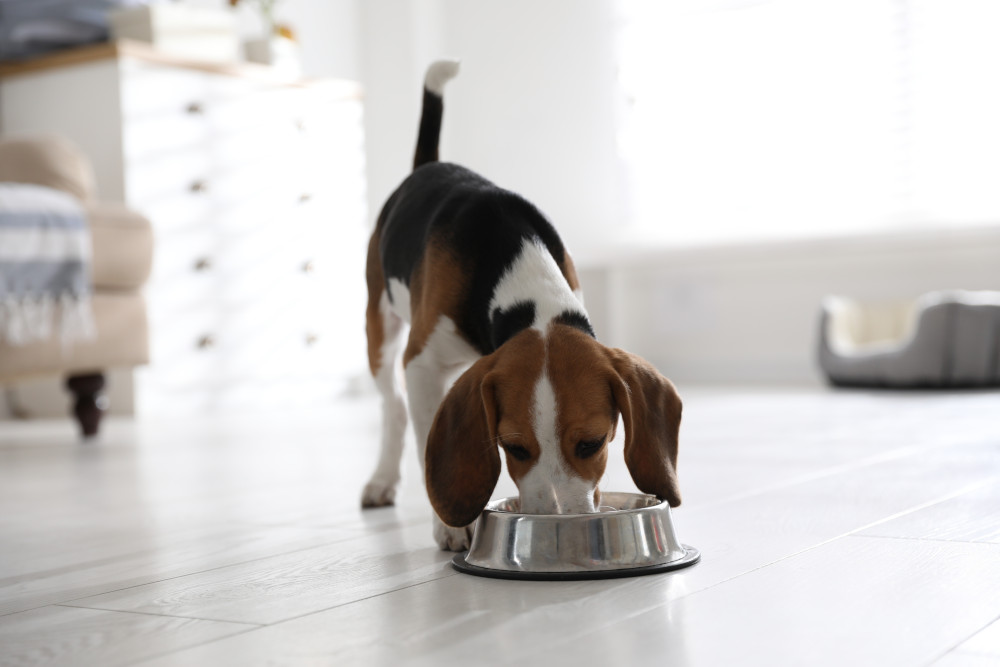
Feeding location and bowl type also play an important role. Feed your puppy in a quiet area of the house to help them feel safe and relaxed while eating. In households with multiple dogs or puppies, feed them separately to reduce stress and prevent competition. This also makes it easier to monitor each puppy’s food intake.
Choose a food bowl that suits your puppy’s needs, considering its size, stability and material. Shallow, stable, non-slip bowls may be easier for puppies to access and can help prevent tipping over during meals, while appropriately sized bowls can encourage comfortable eating from an early age. Durable, hygienic materials that are easy to clean, such as stainless steel and ceramic, are good options, with heavier bowls potentially providing greater stability [6].
Puppies can be gradually introduced to simple puzzle feeders from around 8-10 weeks of age. These can provide opportunities for exploration, encourage natural foraging behaviours and problem-solving [6]. Start with simple options that allow your puppy to access the food easily to prevent frustration and ensure a positive learning experience. Suitable options include snuffle mats and basic rolling feeders with large, easy‑access holes. At this age, puzzle feeders are best used with treats or a small portion of daily kibble rather than an entire meal, to ensure adequate nutritional intake.
If your puppy is not eating normally or shows any signs of difficulty eating, seek advice from your veterinarian immediately. Never force a puppy to eat, as this can be dangerous, stressful, and may put them off eating altogether.
What should my puppy drink?
Ensure clean, fresh drinking water is available at all times. Provide multiple water sources in quiet locations so your puppy does not have to look for or travel far to drink and ensure water bowls are kept clean. Do not provide milk as this can cause gastrointestinal upset.
If you’re concerned that your puppy is not drinking enough, or you notice changes in how much they are drinking, seek advice from your veterinarian.
Teething
Between four to six months of age, the permanent teeth appear and grow rapidly. You can introduce puppy-specific chew toys and dental treats that may help your puppy with teething and oral health, but it is important to choose appropriate and safe products. The global Veterinary Oral Health Council lists dental products that meet standards for safety and reducing plaque and tartar. You can also speak to your veterinarian if you’re not sure which products are suitable.
Treats
There are a wide range of commercial puppy treats available that are designed to be suitable for developing puppies. However, not all treats are equal. Choose treats that are appropriate for your puppy's age and stage of development.
When deciding which treats are best for your puppy, choose high‑quality products and consider your puppy’s individual preferences and dietary needs. Used appropriately, treats can be helpful for training and interactions with your puppy, and offering some variety can help keep your puppy interested and engaged.
Appropriate treats, offered in moderation, can support your puppy's health and wellbeing. However, treats should not replace a complete and balanced diet and should always be offered in moderation, as excessive treat consumption can lead to obesity. Be mindful of any allergies, sensitivities or individual dietary requirements your puppy may have.

Used in moderation, treats can be a great way to support training while keeping your puppy interested and engaged.
Other foods
Your puppy should be fed a complete and balanced diet appropriate for their life stage and health status. Other foods should only be offered occasionally as treats and should not form the main part of their diet.
Puppies may be given fish, such as tinned sardines, tuna, or salmon, as an occasional treat, but fish should not be fed regularly. Take care to avoid fish bones and choose fish canned in spring water rather than oil or brine.
Puppies can also be fed a small amount of cooked vegetables such as pumpkin or carrots. A small amount of plain cooked pasta or rice may also be offered.
Cooked meat, such as boiled chicken or lamb, may also be offered occasionally. Make sure it does not contain cooked bones, onions, onion sauces or other ingredients that may be harmful to dogs.
Puppies should have access to safe grass. Make sure it has not been chemically treated and that your puppy does not have access to toxic plants. Puppies will sometimes eat grass. The reasons for this behaviour are not fully understood, but it is generally considered normal in otherwise healthy dogs.
Calcium powder supplements should not be given, unless specifically advised by a veterinarian.
Feeding bones and raw meat
Bones (cooked and raw) and raw meat are not recommended due to the potential health risks. Raw meat can carry bacteria that can make both animals and humans ill, while bones can cause dental injuries, constipation, and internal blockages [3].
Dogs have evolved significantly from their wolf ancestors, including developing an ability to digest starch and fat. Feeding them bones is not necessary given the range of quality nutritionally complete and balanced diets available [1].
However, if you do choose to offer bones to your puppy despite these risks, choose only human-grade products. Bones should always be raw and introduced gradually. Choose appropriately sized raw bones that your puppy cannot fit entirely in their mouth or swallow whole. Never feed your puppy cooked bones as these can splinter, causing potentially fatal internal damage or blockage. Always supervise your puppy if they are eating raw bones.
Avoid large, hard marrow bones, T-bones, ‘chop’ bones (e.g. lamb cutlets), large knuckle bones, or bones sawn lengthwise.
Avoid raw meat products marketed as pet food, such as pet meat, pet mince, pet rolls and bone products, as well as sausages, sausage meat, and cooked manufactured meats as they can contain sulphite preservatives. Sulphite preservatives have been associated with thiamine (vitamin B1) deficiency, which can be fatal [5].
Harmful foods
Never feed the following substances as they can be harmful to puppies or dogs (note that this is not a complete list):
- alcohol
- onions and onion powder
- garlic
- chocolate, coffee or caffeine products
- mouldy or spoiled foods, or compost
- avocado
- bread dough or yeast dough
- grapes, raisins, sultanas, including those in food such as Christmas cakes
- currants
- nuts, including macadamia nuts
- fruit stones or pits such as mango seeds, apricot stones, avocado stones
- mushrooms
- fruit seeds
- corncobs
- green unripe tomatoes
- cooked bones
- small pieces of raw bone
- fatty trimmings or fatty foods, including butter
- salt
- vegetables cut into large chunks
Also ensure your puppy does not have access to string wrappings around rolled roasts or absorbent pads found under meat when wrapped on trays.
References
Wu G (2024) Recent advances in the nutrition and metabolism of dogs and cats. Nutrition and Metabolism of Dogs and Cats, 1446:1-14.
Bray EE, Zheng Z, Tolbert MK, McCoy BM, Kaeberlein M, Kerr KF (2022) Once-daily feeding is associated with better health in companion dogs: results from the Dog Aging Project. GeroScience, 44(3):1779–1790.
Cline MG, Burns KM, Coe JB, Downing R, Durzi T, Murphy M, Parker V (2021) 2021 AAHA Nutrition and Weight Management Guidelines for Dogs and Cats. Journal of the American Animal Hospital Association, 57:157–178.
Standards Australia (2023) Australian Standard for the Manufacturing and Marketing of Pet Food (AS5812).
Singh M, Thompson M, Sullivan N, Child G (2005) Thiamine deficiency in dogs due to the feeding of sulphite preserved meat. Australian Veterinary Journal 83(7):412-417.
Heys M, Lloyd I, Westgarth C (2024) ‘Bowls are boring’: Investigating enrichment feeding for pet dogs and the perceived benefits and challenges. Veterinary Record, 194(4):e3169.
Was this article helpful?

This work is licensed under a Creative Commons Attribution-NonCommercial-NoDerivatives 4.0 International License.