
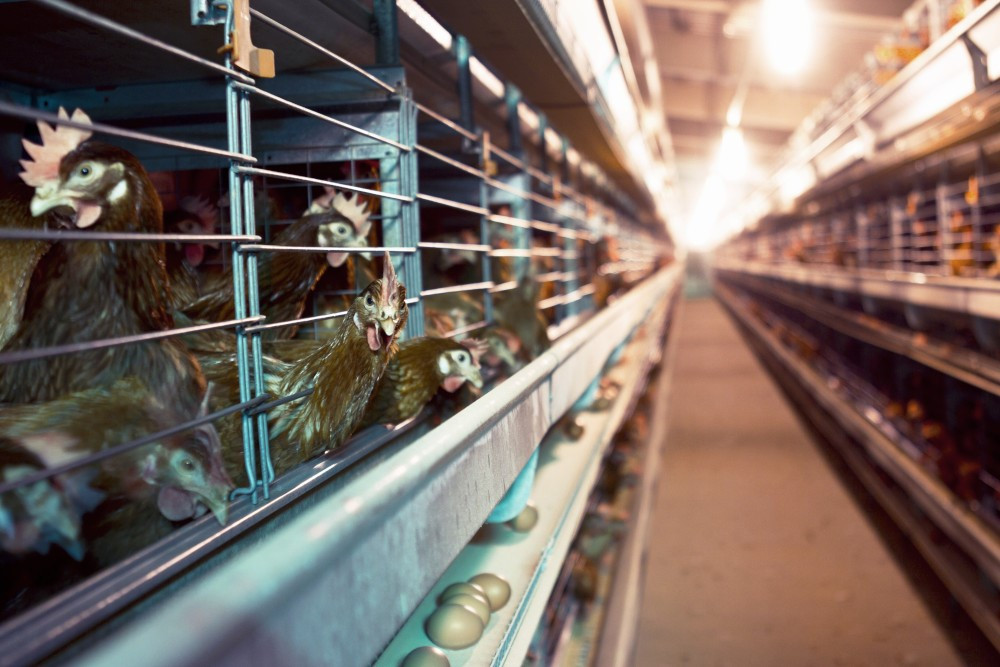
All layer hen housing systems have advantages and disadvantages, but caged housing systems inherently compromise the welfare of layer hens because of the confinement and behavioural restriction they impose. Layer hens will normally choose to nest and lay eggs in enclosed nest boxes, hens will perch and roost at night, forage, and dust bathe in suitable litter substrate if provided the opportunity [1, 2]. Hens in caged housing systems are either unable or severely limited in their ability to perform their normal behaviours that are important for their welfare.
What are battery cages?
Battery cages are small barren wire cages that usually house several birds in each cage and are stacked on top of each other inside a shed, which houses tens of thousands of hens. In a battery cage, each hen is provided less than the size of a piece of A4 paper and cages are only 40 cm high. Hens require at least 540-1980cm2 per hen for behavioural freedom to perform behaviours such as turning around, wing flapping, wing stretching and preening [3–5]. In battery cages, hens barely have enough room to turn around, stretch or flap their wings. Battery cages are also barren, meaning that hens have no opportunity to perform normal behaviours, such as foraging, dust bathing, perching, and nesting [3, 6].
The inspection and management of hens is often considered easier in battery cages compared to cage-free housing systems [7]. The risk of infection (bacterial, viral, or parasitic) is lower in battery cages, which is likely because when hens are confined in cages it is easier to intervene when any health and welfare problems are identified [1, 7].
What are furnished cages?
Furnished cages were developed to improve the behavioural expression that birds lack in barren battery cages while retaining the hygiene and disease control benefits of battery cages. In furnished cages, hens are still kept on wire but are provided with ‘furnishings’ such as a perch, a small amount of litter for dust bathing, a claw-shortening device, and a nesting area. Hens in furnished cages have improved musculoskeletal health compared with hens in battery cages because they have more room to move around [8]. However, when confined in furnished cages hens are unable to express their full behavioural repertoire because their space is still restricted, and the nesting, perching, and litter provision is often inadequate.
What are the animal welfare issues with housing hens in cages?
There are a number of negative welfare outcomes for hens in caged housing systems due to the space and behavioural restriction, which include:
- Limited mobility which negatively affects the skeletal quality and development of layer hens, which leads to increased overall bone weakness and disuse osteoporosis [2, 7–9]. Hens having weaker bones means hens in cages haver higher rates of injuries and fractures at depopulation and handling.
- Inability to perform any comfort behaviours including foraging and dust bathing due to space restrictions and lack of suitable litter substrate [6, 10, 11].
- Increased risk of foot and toe lesions and conditions, such as hyperkeratosis [6, 12].
- Inability to perform perching behaviours during the day and roosting up high on perches at night [1, 2, 13–15].
- Increased risk and incidence of metabolic diseases, such as fatty liver haemorrhagic syndrome which is associated with increased feed intake with minimal exercise [16, 17].
- Inability to escape aggression from other hens [6, 9, 18].
- Inability to perform nesting behaviours during egg laying in cages without nest boxes, which can lead to frustration and increased stress [2, 3, 19, 20].
- Risk of microclimates developing in certain cages due to variation in temperature, lighting, humidity, and air quality at different locations inside the shed, which can expose groups of hens to poorer housing conditions [21].
Do hens housed in cages have increased stress levels?
It is unclear whether the stress levels of hens are different in cage and non-caged housing systems. Stress in hens is usually measured by using corticosterone levels (a stress hormone) in blood plasma, excreta, feathers, or the egg albumen (the clear liquid or egg white contained within the egg). However, corticosterone levels in hens can increase for many reasons (not just stress); sample types do not reliably correlate with each other; levels vary in responsiveness in acute and chronic stress; and does not necessarily correlate to the brain and thus emotional experience of stress in hens [22]. There is a need for further research on the stress physiology of hens in relation to egg-laying behaviour to identify objective and accurate measures of stress and bird welfare.
What is the RSPCA’s view on housing hens in cages?
The RSPCA is opposed to housing hens in cages and has been actively campaigning against battery cages for decades. Battery cages inherently result in poor welfare outcomes for layer hens because of the extreme confinement and behavioural restriction. The ability to perform normal behaviours is important to provide good welfare. Although, cage-free housing systems can have animal welfare issues and challenges, they can be addressed through good system design and management practices. The ultimate aim for layer hen housing systems should be to allow hens to adequately perform normal behaviours, while also optimising management practices to minimise the risk of disease, severe feather pecking, and fractures.
The whole of the European Union and the United Kingdom have legally phased out battery cages, and several states in North America, Canada, and New Zealand have also phased them out. The Australian Poultry Standards and Guidelines were released in 2022 calling for a phase out of all battery cages across Australia by no later than 2036. An end date for battery cages in Australia would be a win for layer hens, and the community, who have been calling for a phase out for the past forty years. However, unfortunately, states and territories are yet to implement the Standards and, with a date so far into the future, millions of layer hens are continuing to suffer in barren battery cages.
To find out more about the RSPCA’s campaign to end battery cages, click here.
References
[1] Saxmose Nielsen S, Alvarez J, Joseph Bicout D, et al (2023) Welfare of laying hens on farm. EFSA Journal 21:e07789
[2] Hemsworth PH, Edwards LE, Hemsworth PH, Edwards LE (2020) Natural behaviours, their drivers and their implications for laying hen welfare. Anim Prod Sci 61:915–930
[3] Engel JM, Widowski TM, Tilbrook AJ, Butler KL, Hemsworth PH (2019) The effects of floor space and nest box access on the physiology and behavior of caged laying hens. Poult Sci 98:533–547
[4] Mench JA, Blatchford RA (2014) Determination of space use by laying hens using kinematic analysis. Poult Sci 93:794–798
[5] Dawkins M stamp, Hardie S (2007) Space needs of laying hens. http://dx.doi.org/101080/00071668908417163 30:413–416
[6] Bhanja SK, Bhadauria P (2018) Behaviour and welfare concepts in laying hens and their association with housing systems. Indian Journal of Poultry Science 53:1
[7] Hemsworth PH, Hemsworth PH (2021) Cage production and laying hen welfare. Anim Prod Sci 61:821–836
[8] Campbell DLM, Campbell DLM (2020) Skeletal health of layers across all housing systems and future research directions for Australia. Anim Prod Sci 61:883–892
[9] Neijat M, Casey-Trott TM, Robinson S, Widowski TM, Kiarie E (2019) Effects of rearing and adult laying housing systems on medullary, pneumatic and radius bone attributes in 73-wk old Lohmann LSL lite hens. Poult Sci 98:2840–2845
[10] Grebey TC, Ali ABA, Swanson JC, Widowski TM, Siegford JM (2020) Dust bathing in laying hens: strain, proximity to, and number of conspecifics matter. Poult Sci 99:4103–4112
[11] Oliveira JL, Xin H, Chai L, Millman ST (2019) Effects of litter floor access and inclusion of experienced hens in aviary housing on floor eggs, litter condition, air quality, and hen welfare. Poult Sci 98:1664–1677
[12] Ali ABA, Campbell DLM, Siegford JM (2020) A risk assessment of health, production, and resource occupancy for 4 laying hen strains across the lay cycle in a commercial-style aviary system. Poult Sci 99:4672–4684
[13] Giersberg MF, Spindler B, Kemper N (2019) Linear space requirements and perch use of conventional layer hybrids and dual-purpose hens in an aviary system. Front Vet Sci 6:471897
[14] Purdum S, Eusebio P, Hanford K (2020) The effects of 2 genetic lines on spatial distribution and use and preference of perch and nest area in an aviary system. Poult Sci 99:3328–3333
[15] Ali BA, Toscano M, Siegford JM (2019) Later exposure to perches and nests reduces individual hens’ occupancy of vertical space in an aviary and increases force of falls at night. Poult Sci 98:6251–6262
[16] Bryden WL, Li X, Ruhnke I, Zhang D, Shini S, Bryden WL, Li X, Ruhnke I, Zhang D, Shini S (2021) Nutrition, feeding and laying hen welfare. Anim Prod Sci 61:893–914
[17] Groves PJ, Groves PJ (2021) Non-infectious diseases and laying hen welfare. Anim Prod Sci 61:1013–1017
[18] Nannoni E, Buonaiuto G, Martelli G, Lizzi G, Trevisani G, Garavini G, Sardi L (2022) Influence of Increased Freedom of Movement on Welfare and Egg Laying Pattern of Hens Kept in Aviaries. Animals 12:2307
[19] Shi H, Tong Q, Zheng W, Tu J, Li B (2019) Effects of nest boxes in natural mating colony cages on fear, stress, and feather damage for layer breeders. J Anim Sci 97:4464
[20] Shi H, Li B, Tong Q, Zheng W, Feng G (2019) Influence of nest boxes and claw abrasive devices on feather pecking and the fear responses of layer breeders in natural mating colony cages. Appl Anim Behav Sci 220:104842
[21] Edwards LE, Hemsworth PH, Edwards LE, Hemsworth PH (2021) The impact of management, husbandry and stockperson decisions on the welfare of laying hens in Australia. Anim Prod Sci 61:944–967
[22] Tilbrook AJ, Fisher AD, Tilbrook AJ, Fisher AD (2020) Stress, health and the welfare of laying hens. Anim Prod Sci 61:931–943