
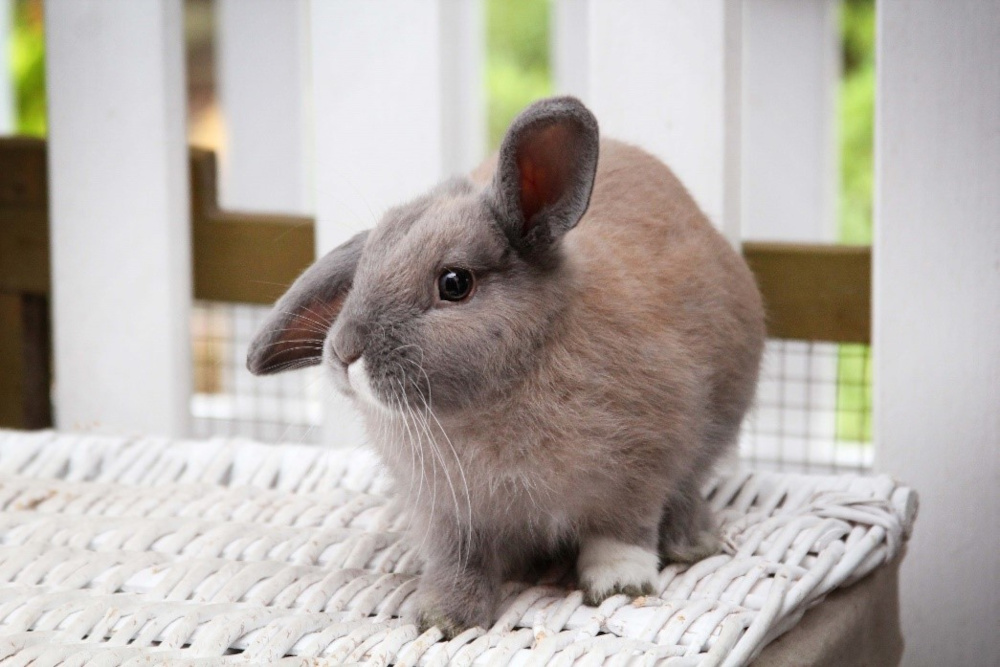
There are about 30 breeds of rabbits, ranging in colours, shapes, and sizes. The most popular breeds are the Dwarf Lop, the Mini Lop, and the Netherland Dwarf, but mixed breed rabbits are very common. They vary greatly in size with their average adult body weight anywhere between 1-8kg! Although all rabbits have similar requirements for care and attention, each breed has different characteristics, grooming needs, and care requirements. So, make sure that you do some research before welcoming a bunny into your family. Rabbits generally live for an average of 6-12 years. They are found in most countries but, unfortunately, are agricultural pests in many parts of the world.
The following provides some general advice about rabbit care.
Are rabbits the right pet for me?
Although rabbits can be inexpensive to buy or are often given away free, they are by no means cheap and easy pets. A rabbit can live for 12 years (making them a long-term commitment), they need to be desexed/neutered, and ideally given the companionship of another bunny (or more). They need yearly vaccinations and full checks from a rabbit-friendly veterinarian. Veterinary care, when needed, can cost as much as it does for a cat or a small dog, and at this time, only a few companies offer pet insurance for rabbits in Australia.
On the plus side, however:
- Rabbits are “crepuscular”, which means they are most active mornings and evenings. This means they can be excellent pets for working adults as they are lively in the mornings when you get up, and always happy to see you when you come home at night!
- They are very clean creatures and can easily be litter trained. They are also smart and can be taught voice commands, learn to ask for treats, use harnesses to go for a walk, and some rabbits are even trained in bunny “agility.”
- They love to interact with people and play with toys, explore their environments, and they can be taught lots of things.
- Contrary to popular belief, rabbits are not good children’s pets – they need gentle handling and lots of interaction. Understandably, most children see rabbits as similar to fluffy toys, but rough play and handling can make bunnies fearful or aggressive.
If, however, you feel you have space, time, and love for a bunny, they are the most delightful pets! They are much smarter than you think and can be very interactive and affectionate! If you have never had rabbits as a pet, you may be in for a very nice surprise.
Where can I keep rabbits?
Wild rabbits are one of Australia’s most destructive pest animals. They have a significant negative and costly impact on agriculture through overgrazing, they endanger many threatened plant species and ecological communities, and they compete with native animals for food and water. Rabbits are classified as a pest in every state of Australia.
However, not all states ban keeping rabbits completely. It’s not the domesticated, desexed rabbits that are the issue, it is the wild (feral) rabbits. All Australian states and territories (except Queensland) allow you to keep pet (but not feral) rabbits. Queensland totally bans the keeping of rabbits as pets (only circuses, magicians, and universities can have them and only under a special license). Hefty fines are applied to people found keeping rabbits illegally in Queensland.
One rabbit or two (or more)?
Rabbits are a social species and should not be kept alone, or without at least one other rabbit with whom they are compatible. Generally, rabbits should live as part of a bonded pair of rabbits; this is a process that takes some time and patience but, if successful, will hugely improve your rabbits’ quality of life. See our article on bonding rabbits to each other, and to people.
Where can I obtain a rabbit?
You should always try to make sure that you are purchasing your rabbits from a reputable source – whether that be from a breeder, pet store, or rescue organisation. Reputable shelters and rescue groups will ensure their rabbits are vaccinated and desexed as well as given an overall health and behaviour assessment prior to being available for adoption. Check out the RSPCA website Adoptapet to see rabbits who are available for adoption. Prior to taking the rabbits home, it is important to note the environment that they are living in. Their hutches or runs should be kept in an appropriate area, and they should be clean, dry, and not overcrowded. There should be appropriate food and clean, fresh water readily available. Ask about vaccination histories, medical problems, and veterinary care. If you have doubts about the seller, it may be best to go somewhere else.
What does a healthy rabbit look like?
Before taking your new rabbits home, you should take the time to have a closer look for problems. Remember, rabbits are a prey species and, as such, are very good at hiding signs of illness when they feel threatened. Settle your rabbits on your lap or a table, and look at the following:
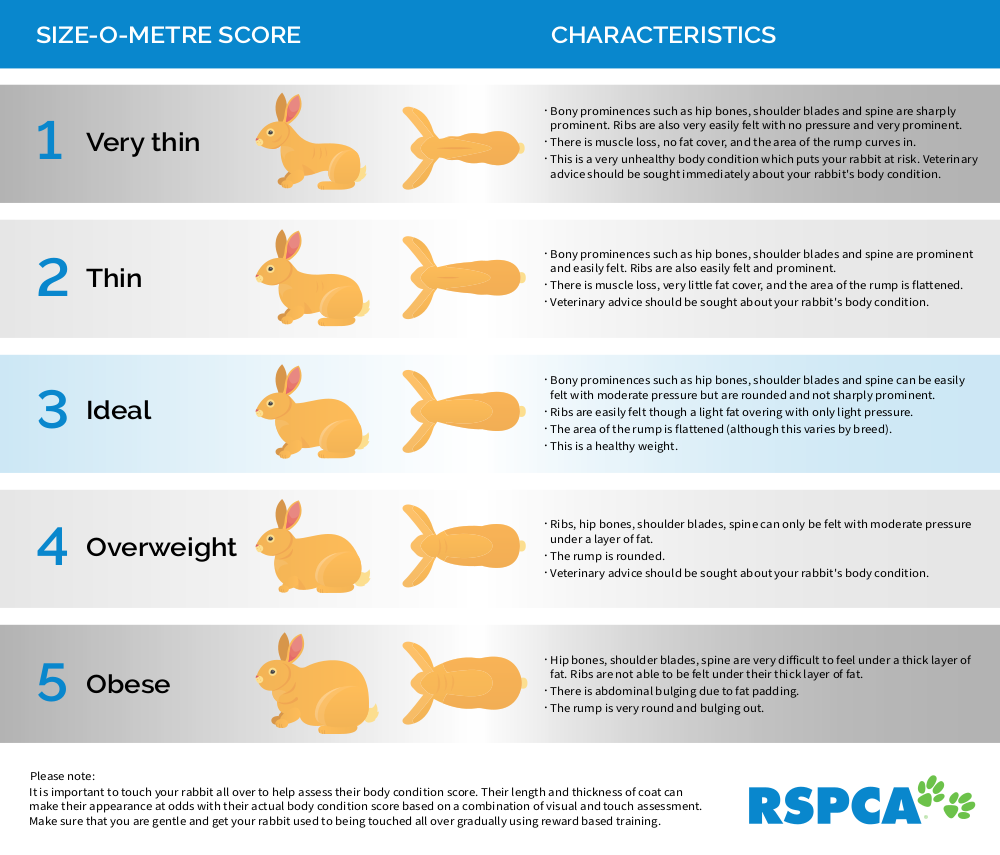
- The spine and pelvic bones should not be prominent, nor should the rabbits be overweight (see chart below).
- The eyes should be clear and bright, with no discharge, puffiness, excessive blinking, or cloudiness.
- The nostrils should be clean and dry, with no evidence of discharge. Watch and listen for any sneezing.
- There should be no abnormal swellings on the cheeks or jaws, nor should there be any drooling or problems chewing.
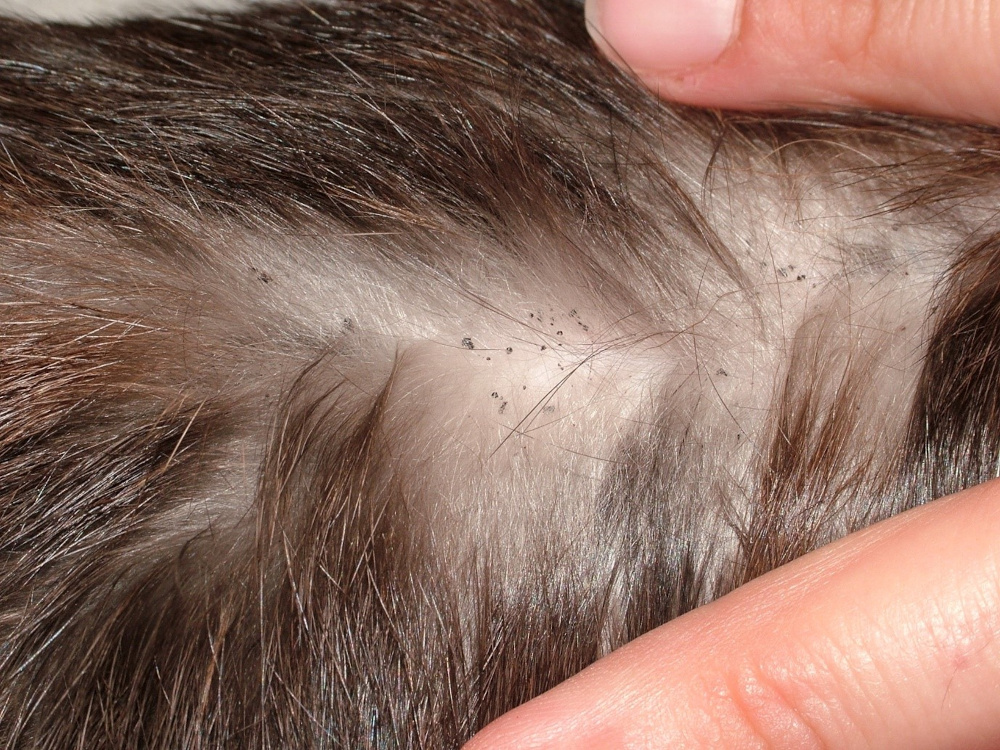
- Brush the hair and part it to examine the skin. Look for flaking, bald patches, fleas or flea dirt, or fur mats.
- The tail and backside of the rabbits should be clean and dy. Look for evidence of diarrhoea, urine scalding, or fly strike (maggots).
- Do the nails need clipping? If they are showing over the fur of the rabbit’s feet they probably do, and indoor rabbits often need their nails trimmed.
- Look under the back legs and hocks for bald spots, ulceration, or bleeding (note rabbits only have hair on their feet, they do not have foot pads like cats and dogs)
- General behaviour – are the rabbits inquisitive, alert, and moving freely?
- It can require some skill to identify the sex of a young rabbits correctly. Make sure you are buying from someone that has experience in identifying the sex of young rabbits.
Don’t buy a rabbit who looks unwell just because you feel sorry for them. Doing this can result in a lot of veterinary bills almost immediately after purchase.
Care of your new pet rabbits should start with a thorough examination by a rabbit veterinarian. Not all veterinarians are comfortable seeing rabbits, so check first and find a veterinarian near you happy to see them. The veterinarian will examine your rabbits for any signs of illness and provide you with detailed information on husbandry such as what to feed your rabbits, how to house them, and preventative health tips to keep them happy and healthy.
Preparing to bring your rabbits home
Before bringing your new rabbits home, it is important to put some time and thought into caring for them and having everything set up ready to go before their arrival. Things to give some thought to, and prepare for, include:
- Where should I keep my rabbits?
- What am I going to feed my rabbits?
- How will I keep my rabbits entertained, alert, and interested in their surroundings?
- How will I keep my rabbits safe against household hazards?
Where should I keep my rabbits?
Rabbits can be housed indoors, outdoors, or a combination of both. A rabbit’s enclosure, indoors or outdoors, consists of two parts:
- A hutch: an enclosed area where your rabbits can hide, sleep, and eat.
- An exercise run: usually attached to the hutch, although for some rabbits housed indoors, your house may be the exercise area.
There are some basic considerations for housing, and then special factors that depend on the location where the rabbits are housed. These are discussed in this article.
What am I going to feed my rabbits?
Rabbits are herbivores (they eat plant material). In the wild, they eat predominantly grass, grazing for up to 6-8 hours a day. Their whole digestive tract from their teeth right down to the end of their gastrointestinal tract is adapted to this diet and eating pattern. Providing a constant supply of grass and/or grass hay is paramount in providing a balanced diet. It can be supplemented with fresh fruit and vegetables, as well as a small amount of special rabbit pellets.
For more information on feeding your bunny, see our article on what to feed your rabbits.
How will I keep my rabbits entertained, alert, and interested in their surroundings?
Environmental enrichment is defined as “the stimulation of the brain by its physical and social surroundings in an attempt to reduce or overcome problems caused by containment”. Its goals are to alter the rabbits’ behaviour in captivity so that it is like the normal behaviour of rabbits in the wild. The aims of environmental enrichment are to provide activities for the rabbits to engage in that ‘fill’ the empty parts of the day and stimulate the rabbits’ s brain while doing so. Doing this helps to prevent behavioural and physical problems that develop when a rabbit is not adapted well to their environment.
There is a tendency to think that environmental enrichment means just providing some toys or other distractions. This is only a small part of the process. For suggestions on how to enrich your bunny’s life, see here.
How will I keep my rabbits safe against household hazards?
Many rabbits are kept indoors, with free range of the house and even parts of the yard. Like small children, however, unsupervised activities can put your rabbits at risk. Rabbits are great chewers, so the most dangerous household hazards are things that they can chew on and hurt themselves, such as electrical cords and toxic plants, and soft plastics that can be a choking hazard. Other dangers are not immediate, but they can cause health problems for your rabbits over time. See our article on household hazards here.
General care of rabbits
Handling
Think about it … rabbits are prey animals. The only time a wild rabbit leaves the ground is when they are about to be eaten! So, although you can and should train your pet rabbits to tolerate routine handling, they may never enjoy being picked up and cuddled. Rabbits who are properly socialised (including being handled appropriately) from a young age tend to be calmer and more confident when handled. They are also more likely to be less stressed and even enjoy being handled if they have been adequately socialised. See our article on socialising rabbits with people and other rabbits here.
The way that rabbits have evolved to run – in leaps and bounds – means they have very long, flexible spines. Wild rabbits have stronger bones, stronger back muscles, and less weight than a pet rabbit (due to the differences in lifestyle). Pet rabbits therefore must be handled gently, carefully, and securely. Even when they are calm and well socialised, sometimes rabbits can panic and may struggle or jump from your arms; this can cause them to suffer serious spinal injuries.
A rabbit should never be ‘tranced’ or ‘hypnotised’; this involves holding a rabbit on their back, causing them to freeze. This is part of the flight, fight, freeze response and is how some prey animals react when captured by a predator. Many people misinterpret this ‘trance-like’ behaviour as evidence that the rabbits are happy – in fact, they are frozen with fear. Rabbits exhibiting this behaviour are extremely distressed. It is unacceptable to subject rabbits to this kind of treatment.
Move slowly and use a quiet calm voice to avoid scaring them. A calm rabbit is generally easier to handle, and the less stressed your rabbit is the less likely they are to panic and potentially injure themselves. Where possible, handling and interactions with rabbits should be at ground level. This is generally considered to be less threatening and stressful for the rabbits, and also there is less risk of injury if the rabbits do escape from your arms.
Any interactions between children and rabbits must be supervised for the safety and welfare of both the child and rabbits. All interactions with younger children must be at ground level. Only adults and older children who are responsible and have been adequately taught how to handle rabbits should be allowed to pick up a rabbit and this should be closely and carefully supervised.
Learning to pick up a rabbit correctly can prevent the rabbit feeling afraid of you and trying to avoid contact at other times. Here are some ‘rules’ for handling rabbits:
- Don’t persist if your rabbits become stressed or agitated or is struggling. Put the rabbits back on the ground and let them recover.
- Rabbits should not be held or lifted by the scruff of their neck; proper gentle handling should be used instead. Appropriate handling will be safer and less distressing to the rabbits.
- A rabbit must never be lifted or held by the ears. This is distressing, painful, and cruel, and can also damage the ears.
- Always support the rabbit’s spine. There are many right and wrong ways to pick up a rabbit but as a rule, use one hand under the front legs to support the chest, while the other is under the rabbit’s bottom, taking the bulk of the weight. This hand is very important – if a rabbit feels unsafe, they will struggle and, if dropped, may suffer severe injuries.
- Prevent the back legs from kicking – wrapping a rabbit in a towel (a ‘bunny burrito’, see below) can help to prevent this behaviour.
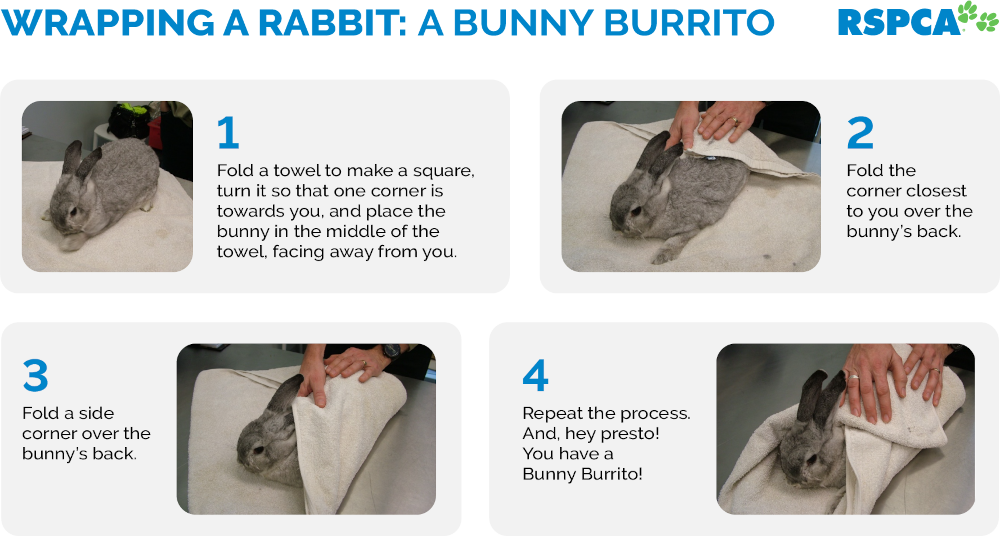
Remember, you can train your rabbits to be lifted but this should be an exceptional occurrence, with normal interaction happening on the floor. The repeated stress of lifting your rabbits may lead to fear and aggression and, although some rabbits will tolerate it (especially if well socialised as young rabbits, or “kits”), it is important for you to recognise that regular handling is for your benefit, not your rabbit’s.
Litter training
Spending a significant portion of their day in their burrow or “den”, wild rabbits prefer not to defecate or urinate where they eat or sleep. Instead, they eliminate in shallow, horseshoe-shaped “scrapes” in the ground, which signal the territory of their warren. Adult males or “bucks” also deposit strong-smelling hard faeces in scattered places to mark their territory. These behaviours can be used to teach your rabbits to use a litterbox.
Rabbits are generally quite easy to litter train, although occasional accidents may occur. The quickest way to house-train your rabbits is to start off with a litter tray in a smaller area (put some hay in it – rabbits like to ‘poo and chew’ at the same time!), usually where they have chosen to go to the toilet and gradually increase the area they are allowed to access only once they are reliably using their tray. It is also vital to have your rabbits desexed as soon as they are old enough – male rabbits can spray like tom cats unless they are neutered and will leave scent-marking poops scattered around to mark their territory.
For more information see our article on how to litter train your rabbits.
Grooming
Regular grooming will help to keep your rabbits’ coat in good condition. This also means that the rabbits will ingest less hair themselves and reduce the risk of hairball blockages in their gastrointestinal tract (this is especially important for long-haired breeds). See our article on grooming here.
Preventative health care
Rabbits can live for up to 12 years provided they are well cared for. Part of this care includes regular yearly veterinary check-ups. At this time, your veterinarian can check your rabbits’ general health, vaccinate them, check their teeth for signs of dental issues (which are very common), and discuss your rabbits’ care and husbandry. In addition, you should take your rabbits to the veterinarian if you notice any signs of a problem such as poor appetite, lethargy, weepy eyes, sneezing, diarrhoea, or any scratches or cuts. Remember, rabbits are a prey species and, as such, are very good at hiding signs of illness when they feel threatened and so any (even mild) signs of pain or illness, should prompt action.
It’s essential that you register with a ‘rabbit-savvy’ veterinarian even if you have no immediate need for one; you can never predict when an emergency will arise. Veterinarians in training spend less time learning about rabbits than they do cats or dogs. Rabbits medicine is often taught alongside “exotic species”, as rabbits are also very different from cats and dogs physiologically, behaviourally, and anatomically. Veterinarians who are keen to treat rabbits usually have to organise additional training outside their course, often in their own time, and at their own expense. These individuals are truly dedicated to providing your rabbits with the best possible care. So, it is important to choose a veterinarian who has specific knowledge of rabbits. Talking with other rabbit owners is often the best way to get recommendations for a knowledgeable veterinarian.
Preventative health care includes desexing, vaccinations, and parasite control.
Desexing
Desexing has numerous benefits for both male and female pet rabbits including: reducing problem behaviours; facilitating easier bonding with new rabbits joining the family; preventing unwanted pregnancies; and minimising health issues in the future such as cancer of reproductive organs. See our article on desexing rabbits here.
Vaccinations
Rabbit calicivirus disease or Rabbit Haemorrhagic Disease Virus (RHDV)
This disease occurs in wild and domestic rabbits in Australia causing acute internal haemorrhage and sudden death. There are two types of RHDV present in Australia (RHDV1 and RHDV2). RHDV1 is has been used as a biological control agent to reduce the feral rabbit population in Australia since 1996, while RHDV2 was first detected in 2015 in Australia, and has also significantly affected both wild and domestic rabbit populations.
Australian veterinarians have been using the CYLAP vaccine (which contains an inactivated RHDV1 strain) since 1997. When RHDV2 became the predominant strain in Australia, the recommendation for the use of CYLAP changed to an increased dose frequency of every 6 months, in the hope was that an increased vaccination regimen would be more likely to confer cross-protection to RHDV2, while acknowledging that CYLAP only contained RHDV1.
In May 2022, a new vaccine was approved (FILAVAC VHD K C+V) against both RHDV1 and RHDV2 virus strains. Rabbits should be vaccinated every 6-12 months against Rabbits Haemorrhagic Disease Virus (Calicivirus) to protect them against this fatal virus. Your veterinarian will be able to advise you on a suitable vaccination program for your bunny. For more information about how to protect your rabbit against RHDV, see this article.
Myxomatosis
This is a poxvirus spread between rabbits by close contact, and by biting insects such as fleas and mosquitoes. The virus causes swelling and discharge from the eyes, nose, and anogenital region of infected rabbits. Most rabbits die within 10-14 days of infection however highly virulent strains of the myxoma virus may cause death before the usual signs of infection have appeared.
Myxomatosis was introduced to Australia in 1950 to reduce pest rabbit numbers. The virus initially reduced the wild rabbit population by 95% but since then, resistance to the virus has increased and less deadly strains of the virus have emerged. Pet rabbits do not possess any resistance to myxomatosis, and mortality rates are between 96-100%. With such a poor prognosis, treatment is not usually recommended.
Vaccination against myxomatosis is not permitted in Australia, so limiting exposure is the best preventative measure.
- Put mosquito netting around your rabbit’s hutch even if indoors (this will help to prevent flystrike as well).
- If your rabbits are allowed to exercise outside, avoid letting them out in the early morning or late afternoon when mosquitoes are more numerous.
- Please talk to your veterinarian about flea prevention for rabbits. You can use Revolution® (Selamectin) or Advantage® (Imidocloprid) for flea prevention, but you must check first with your veterinarian for dosages. Do not use Frontline® (Fipronil) as this is often fatal to rabbits.
For more information see this article.
The Australian Government maintains that, because the myxomatosis vaccines are modified live-virus vaccinations (meaning they contain weakened forms of the virus), the weakened viruses in the vaccine could spread from domestic rabbits to the pest rabbit population, possibly immunising them against myxomatosis. RSPCA Australia has repeatedly called for a review of available myxoma virus vaccines and a scientific assessment of their likely impacts in the Australian setting. We would like to see action taken to ensure that all domestic rabbits can be protected against contracting myxomatosis.
For more information see this article.
Parasite control
Rabbits are prone to a variety of external parasites, including ear mites, fur mites, fleas, and flystrike.
Ear mites
Ear mites mainly affect the ears but can also affect other body areas. In the ears they often cause severe crusting inside the ear and signs of irritation, like ear scratching and head shaking. Many affected rabbits will develop sores from scratching themselves, these in turn may become infected with bacteria. Selamectin (Revolution®) will also treat ear mites, it’s best to treat all in contact rabbits and thoroughly clean cages as well. Do not use fipronil (Frontline®) as it is rapidly fatal to rabbits.
Fur mites
Like fleas, these little crawlers can also bite people, so if handling your bunny is producing a rash on your arms or abdomen, then a closer look at the fur with a microscope is in order. Most rabbits with a mite infestation will have dandruff and itchy skin, mainly over their back, between their shoulder blades and above their tail. Often rabbits with fur mite infestations will have an underlying issue, so a veterinary check-up is a good idea. Selamectin (Revolution®) will treat these nasties and decontamination of the environment is advised. Do not use fipronil (Frontline®) as it is rapidly fatal to rabbits.
Fleas
Dog and cat fleas can and will infest rabbits, causing intense irritation. They are usually found around the face and ears. Selamectin (Revolution®) or imidocloprid (Advantage ®) can be used from 8 weeks of age, to treat these pests on your pet. Check with your veterinarian first to make sure you are using the right product and dose. Remember to treat all your pets and the environment, to avoid rapid re-infestation. Do not use fipronil (Frontline®) as it is rapidly fatal to rabbits.
Fly strike
This is a condition occurring when flies lay their eggs in dirty, matted fur (often under the tail). When they hatch into maggots, these will rapidly mature and eat into the living flesh within 24 hours. This is often rapidly fatal for the rabbits. Flystrike is most common in summer (due to the increased heat, humidity, and flies), and rabbits with a dirty bottom (most likely because of poor diet, or inadequate grooming), wounds, or wet fur, are most at risk.
Prevention is the best approach, and revolves around:
- Feeding a healthy diet (See our article on feeding).
- Remove soiled bedding every day and disinfect hutches weekly.
- Check your rabbits at least once a day: “high-risk rabbits” need twice-daily bottom checks especially in warm weather.
- Don’t forget that house rabbits can also be at risk!
- The use of physical barriers such as adding fly screens or mosquito nets to hutches and runs
References
1. Jenkins JR (2001) Rabbit Behavior. Vet Clin North Am Exot Anim Pract 4:669–679
2. Rabbit Welfare Association and Fund (2023) How to keep pet rabbits happy and healthy. Accessed 15 Feb 2023
3. Crowell-Davis S (2021) Rabbit Behaviour. Vet Clin North Am Exot Anim Pract 24:53–62
4. Varga M, Harcourt-Brown F (2014) Textbook of Rabbit Medicine, 2nd ed. Elsevier
